

Table of Contents
When it comes to making your outdoor stairs both safe and stylish, solar deck lights for stairs are an absolute game-changer. Not only do they illuminate pathways for safer footing at night, but they also elevate the aesthetic appeal of your deck or backyard. Whether you’re tackling DIY projects or seeking professional-grade results, this guide dives deep into everything you need to know about solar deck lights.
Why Choose Solar Deck Lights for Stairs?
Before we jump into installation tips, it’s important to understand why solar deck lights for stairs are so popular. Here’s what makes them a must-have:
Energy Efficiency and Eco-Friendliness
Unlike traditional wired lighting, solar-powered lights harness the sun’s energy, saving on electricity bills. According to the U.S. Department of Energy, outdoor solar lights can reduce household energy costs by up to 50% if used strategically.
Safety and Visibility
Dark stairways are a major cause of outdoor accidents. Installing solar step lights outdoor enhances safety by clearly outlining stair edges. In fact, the National Safety Council reports that nearly 1 in 3 stair-related injuries occur at night, emphasizing the need for well-lit stairs.
Easy Installation and Low Maintenance
No wiring, no trenching, no electrician—just simple mounting. Most modern solar deck lights for stairs are designed for DIY-friendly installation. With a bit of patience, even a novice can have professional-looking results.
Types of Solar Deck and Stair Lighting
Choosing the right solar deck lights for stairs isn’t just about looks — it’s about safety, durability, installation method, and how your deck is actually used in real life. I’ve seen homeowners buy the prettiest lights online only to realize they glare too much, don’t charge properly, or crack after one winter.
Below is a breakdown of the main types of solar deck and stair lighting, based on hands-on installation experience and long-term performance in real outdoor conditions.
Surface-Mounted Solar Step Lights Outdoor
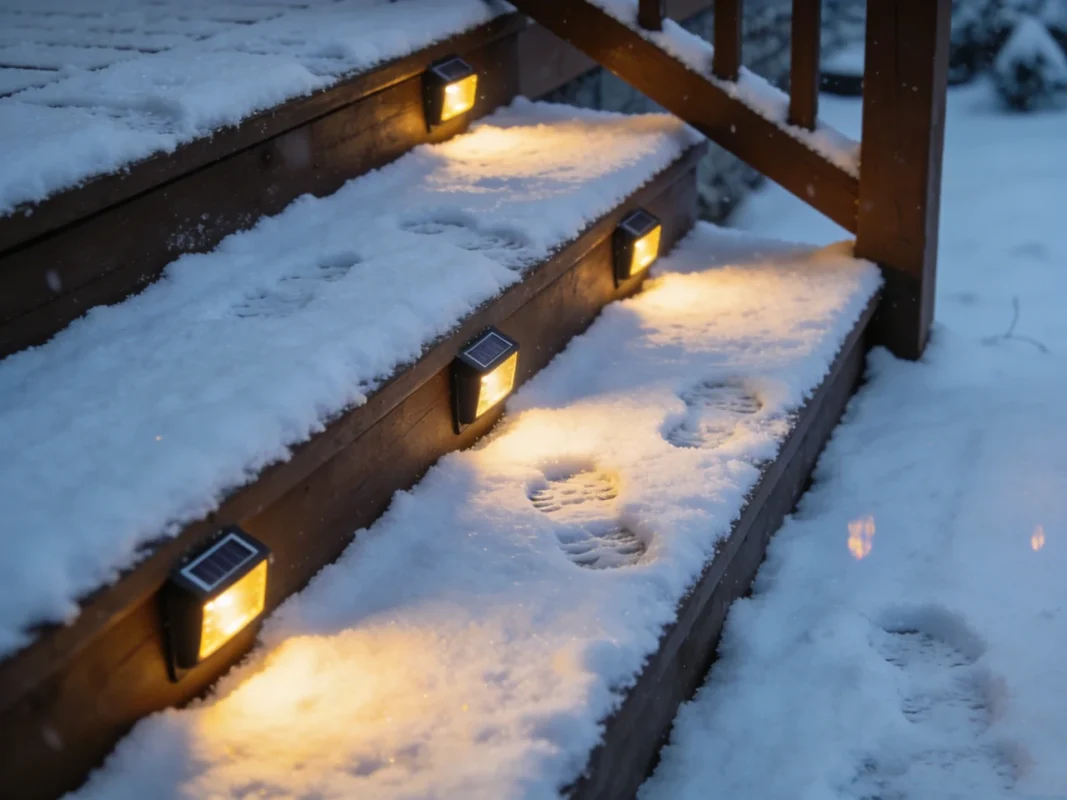
Surface-mounted solar step lights outdoor are the most common style for stairs. They attach directly to the stair riser (the vertical face of each step) or along the side stringer.
Why they’re popular:
- Easy DIY installation
- No cutting or routing required
- Ideal for retrofitting existing decks
- Great for wood, composite, or PVC decking
When installed correctly, surface-mounted solar deck lights for stairs create a soft downward glow that highlights the edge of each tread. The key is positioning them slightly below eye level to avoid glare.
Field tip:
If you mount them too high on the riser, the light can shine directly into your eyes when walking up. Keep them centered horizontally and about 1–2 inches below the tread lip for the best effect.
These are also a smart option when you want true waterproof deck lighting without drilling into the structural part of the stair. Most quality models are sealed and rated for rain, snow, and temperature swings.
Recessed LED Stair Lights for Deck
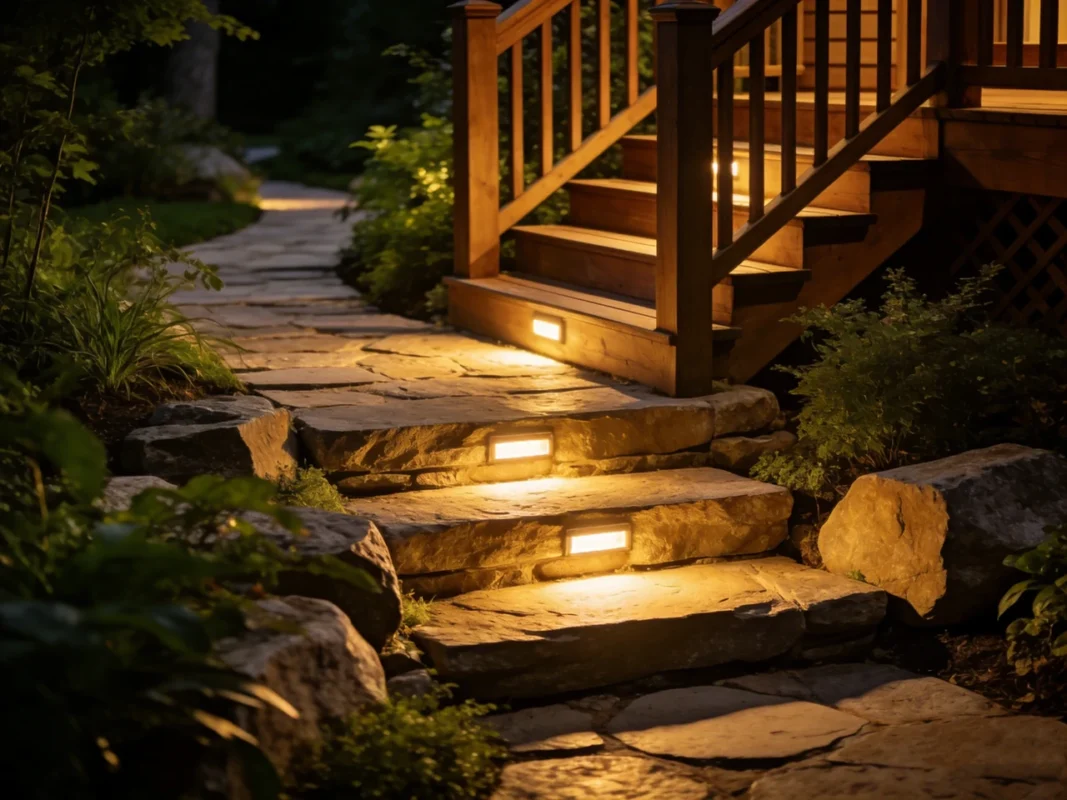
If you want something sleek and low-profile, recessed led stair lights for deck are the premium choice. These are installed flush into the riser or stair surface.
Why homeowners choose recessed lighting:
- Clean, architectural appearance
- No protruding edges
- Reduced tripping risk
- Excellent durability in high-traffic areas
Recessed solar deck lights for stairs require cutting into the deck material, so they’re best installed during a deck build or major renovation. That said, experienced DIYers can retrofit them with proper tools.
Important consideration:
Measure twice. Cutting into composite or hardwood decking is permanent. Always check the light housing depth and ensure you’re not interfering with structural components.
These lights are ideal if stairs are heavily used — for example, leading to a pool or patio — because they can handle foot traffic better than surface-mounted options.
Solar Fence Post Lights for Vertical Accents
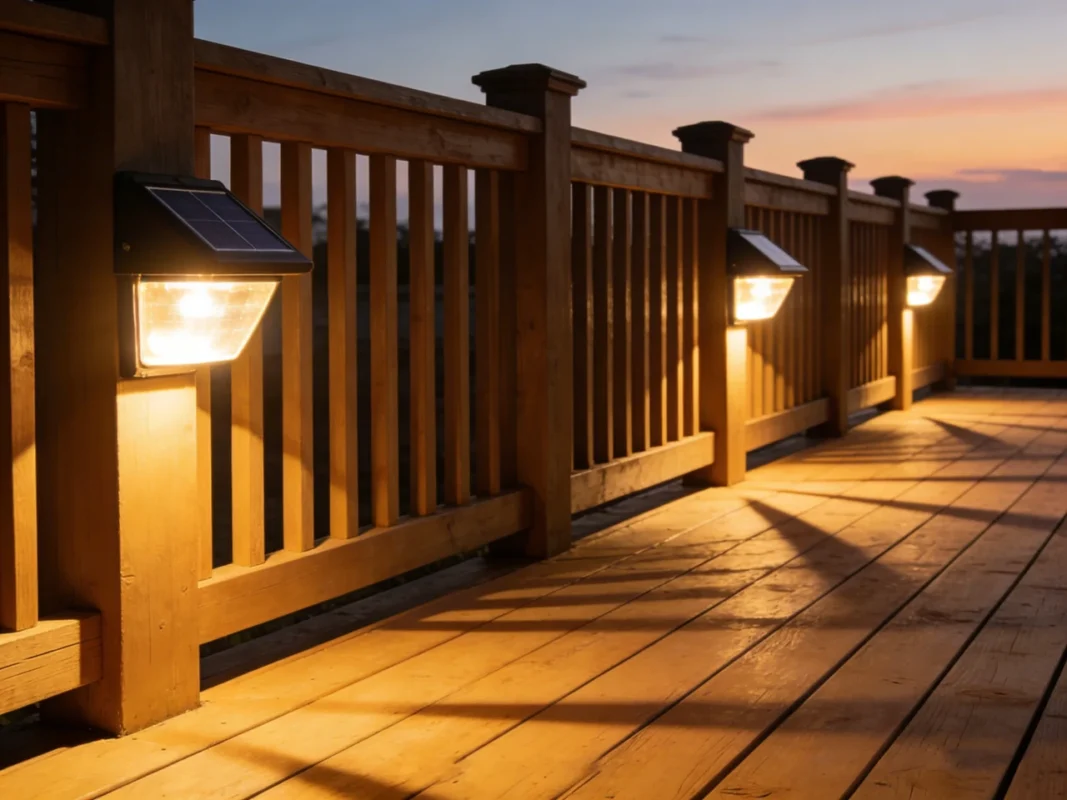
While not technically stair lights, solar fence post lights are often used alongside solar deck lights for stairs to create a layered lighting effect.
Installed on railing posts or deck perimeter posts, they provide:
- Vertical illumination
- Ambient glow
- Improved overall visibility
- A finished, cohesive look
In my experience, combining stair lights with post lights makes a deck feel professionally designed instead of pieced together. The stairs handle safety. The posts handle ambiance.
If your stairs connect to a larger deck, this combination creates depth and visual continuity — especially useful for entertaining spaces.
Solar Driveway Marker Lights for Transition Areas
When stairs connect directly to a driveway or walkway, solar driveway marker lights can bridge the gap between ground-level paths and elevated steps.
These are typically:
- Low-profile
- Designed for edge marking
- Weather-resistant
- Visible from a distance
Used strategically, they help guide guests toward the staircase before they even reach it. This is particularly helpful in rural or low-light properties where ambient light is minimal.
Some homeowners also install these along the sides of wide staircases for additional edge definition.
Outdoor Pathway Step Lights
If your property has multiple elevation changes, outdoor pathway step lights extend lighting beyond just the deck stairs.
These lights are ideal for:
- Garden steps
- Landscape terraces
- Stone or concrete pathways
- Entryway transitions
Unlike focused stair riser lights, pathway models cast a wider beam pattern. When paired with solar deck lights for stairs, they eliminate dark gaps between outdoor zones.
From a safety standpoint, consistent lighting across all elevation changes significantly reduces nighttime trip hazards.
Integrated Solar Safety Lights for Stairs
For homeowners primarily concerned with visibility and accident prevention, solar safety lights for stairs are specifically designed to maximize clarity.
These often feature:
- Wider light spread
- Anti-glare lenses
- Slightly higher lumen output
- Enhanced waterproofing
If you have older family members, frequent guests, or icy winters, safety-focused lighting is worth prioritizing over purely decorative styles.
In colder climates, I always recommend selecting models specifically rated for freeze-thaw cycles. High-quality waterproof deck lighting prevents internal condensation, which is one of the biggest causes of failure over time.
Low-Profile Walkable Solar Lights
Some modern solar deck lights for stairs are built to be walkable. These are designed to sit flush within stair treads or landing platforms.
They’re useful when:
- You want subtle edge lighting
- You don’t want visible fixtures
- You need durable lighting on wide deck landings
However, not all walkable lights are suitable for stair treads themselves. Always confirm load capacity before installation.
Choosing the Right Type for Your Situation
Here’s how I advise homeowners to decide:
- Retrofitting an existing deck? → Surface-mounted solar step lights outdoor
- Building a new deck? → Recessed led stair lights for deck
- Want a polished design look? → Combine solar deck lights for stairs + solar fence post lights
- Concerned about maximum visibility? → Solar safety lights for stairs
- Connecting driveway to stairs? → Add solar driveway marker lights
- Multi-level landscaping? → Integrate outdoor pathway step lights
The best installations aren’t about choosing one type — they’re about layering strategically.
Key Features to Look For in Solar Deck Lights
Not all solar deck lights for stairs are created equal. I’ve replaced enough poorly made fixtures to tell you this: the difference between a light that lasts five years and one that fails after one winter usually comes down to a handful of critical features.
If you’re serious about installing solar deck lights for stairs that actually improve safety and don’t become a maintenance headache, here’s what you need to evaluate carefully.
- Lumen Output — Bright Enough for Safety, Not Blinding
When it comes to stair lighting, brightness isn’t about aesthetics — it’s about visibility and depth perception.
For most residential decks:
- 20–30 lumens per step works for subtle edge definition
- 30–50 lumens per step improves clarity in darker yards
- Above 60 lumens can create glare on light-colored decking
Too much brightness can flatten shadows and make it harder to judge stair depth. That’s a real safety issue, especially for older adults.
Professionally installed solar safety lights for stairs often prioritize wide beam spread rather than raw lumen power. A well-diffused 35-lumen light is safer than a harsh 80-lumen spotlight.
If you’re also installing outdoor pathway step lights, try to keep the brightness levels consistent so your eyes don’t constantly adjust between zones.
- Waterproof Rating and Weather Resistance
If your lights aren’t truly weather-sealed, they won’t survive long. Period.
High-quality waterproof deck lighting should have:
- An IP65 rating at minimum (protected against water jets and heavy rain)
- Fully sealed battery compartments
- UV-resistant housing
- Corrosion-resistant fasteners
Moisture intrusion is the #1 reason solar deck lights for stairs fail prematurely. Even condensation inside the lens can degrade LED performance over time.
In colder climates, freeze-thaw cycles expand trapped moisture and crack cheap housings. If you experience snow and ice, choose fixtures specifically engineered for winter durability.
- Solar Panel Efficiency
Here’s something most buyers overlook: the size and quality of the solar panel directly affect nightly runtime.
A larger, high-efficiency panel means:
- Faster charging during shorter winter days
- Better performance in partial sun
- Longer illumination after dusk
If your solar step lights outdoor are installed under railings or near trees, panel efficiency matters even more.
Pro tip from real-world installs:
South-facing exposure is ideal in the U.S., but east- or west-facing can work well. North-facing panels struggle unless they receive reflected sunlight.
- Battery Type and Capacity
Most modern solar deck lights for stairs use rechargeable lithium-ion or nickel-metal hydride batteries.
Here’s what you want:
- Replaceable batteries (non-negotiable for long-term ownership)
- 600–1200mAh capacity for standard stair lighting
- 8–12 hour runtime capability
Cheap sealed units with non-replaceable batteries turn into disposable products. After two years, you’ll be buying everything again.
Quality solar safety lights for stairs allow simple battery swaps. That alone can extend the system’s lifespan to five years or more.
- Light Distribution and Beam Angle
Beam angle is rarely advertised clearly, but it matters a lot.
For stair use:
- 90°–120° spread works best
- Downward-facing LEDs reduce glare
- Frosted lenses soften harsh light
The goal is to illuminate the tread surface — not shine directly into someone’s eyes while they’re walking up.
Recessed led stair lights for deck often produce cleaner light lines because they sit flush with the riser. Surface-mounted models need proper placement to achieve the same effect.
- Installation Design and Mounting Options
Even the best solar deck lights for stairs can fail if they’re difficult to mount securely.
Look for:
- Screw-mount capability (more secure than adhesive alone)
- Mounting brackets for angled staircases
- Compact depth for tight risers
If you’re retrofitting an older deck, flexibility in mounting options makes a big difference.
For example, combining stair lights with solar fence post lights creates layered lighting, but you’ll want matching mounting styles for visual consistency.
- Load-Bearing Strength (If Walkable)
Some homeowners prefer flush-mounted or step-integrated lighting. If you’re considering walkable options, verify:
- Load rating
- Impact resistance
- Non-slip lens surface
Not all walkable lights are designed for full body weight. In high-traffic areas — especially near pool decks — structural durability matters.
For transition zones connecting driveways and stairs, solar driveway marker lights often have higher compression strength because they’re built for ground-level use.
- Automatic Dusk-to-Dawn Functionality
Reliable solar deck lights for stairs should turn on automatically at dusk and shut off at dawn.
A dependable light sensor prevents:
- Manual switching
- Accidental daytime activation
- Battery drain
More advanced systems dim when fully charged and brighten with motion. This hybrid approach works especially well for solar safety lights for stairs, balancing energy efficiency with maximum visibility when needed.
- Color Temperature
Color temperature affects both safety perception and design feel.
- 2700K–3000K: Warm white (cozy, inviting)
- 4000K: Neutral white (crisp, modern)
- 5000K+: Cool white (very bright, more security-focused)
For most decks, warm to neutral white works best. Extremely cool light can feel harsh and clinical in residential spaces.
If you’re pairing stair lighting with outdoor pathway step lights, match the color temperature across fixtures for visual cohesion.
- Real-World Longevity and Warranty Support
After years of installing and maintaining solar deck lights for stairs, I’ve found that longevity depends on:
- Sealed electronics
- Replaceable batteries
- UV-stable materials
- Proper installation
Outdoor lighting lives in one of the harshest environments imaginable: sun, moisture, temperature swings, foot traffic, insects, and debris.
If a manufacturer won’t clearly state battery specs, IP rating, or runtime expectations, that’s a red flag.
How to Plan Your Solar Deck Light Installation
Proper planning ensures your installation is both safe and visually appealing.
Mapping Your Stair Layout
Measure the height, depth, and width of each stair. Determine where lights are most needed, usually on each riser or side edge. Consistency is key for both safety and aesthetics.
Calculating Light Spacing
For even illumination, place lights 3–6 feet apart depending on brightness. Outdoor pathway step lights should be spaced to avoid dark spots while preventing excessive glare.
Sun Exposure Considerations
Solar step lights outdoor need direct or partial sunlight to recharge efficiently. Avoid shady areas under overhangs or dense foliage. If sunlight is limited, choose models with larger solar panels or higher-capacity batteries.
Step-by-Step Installation Guide
Installing solar deck lights for stairs isn’t complicated — but doing it correctly makes the difference between clean, professional results and a crooked, underperforming setup you regret six months later.
I’ve installed stair lighting on everything from brand-new composite decks to 15-year-old pressure-treated lumber. The principles are the same every time: plan carefully, measure precisely, mount securely, and protect against moisture.
If you’re wondering whether this is a DIY job or something you should hire out, this section will make that clear.
Step 1: Evaluate Your Stair Structure and Sun Exposure
Before you even open the box, look at your staircase.
Ask yourself:
- Are the risers solid or open?
- Is there enough vertical surface for mounting?
- Do railings cast heavy shadows?
- How many hours of direct sunlight does this area get?
Solar deck lights for stairs rely entirely on solar charging. Even high-quality solar step lights outdoor will underperform if mounted under deep overhangs or dense shade.
In most U.S. regions, south-facing exposure gives the best charge. East- and west-facing work fine. North-facing installations often need higher-capacity batteries.
If you’re adding solar safety lights for stairs in a shaded backyard, consider spacing lights slightly farther apart and choosing models with larger panels.
Step 2: Measure and Mark Placement Carefully
This is where precision matters.
For standard residential deck stairs:
- Install one light per step
- Center horizontally on each riser
- Position 1–2 inches below the tread lip
- Maintain consistent height across all steps
Use a level and measuring tape. Don’t eyeball it.
Crooked placement is the fastest way to make solar deck lights for stairs look amateur. Consistency is what creates that clean, architectural effect.
If your staircase is wide (over 48 inches), you may consider two lights per step for balanced illumination — especially when using lower-lumen led stair lights for deck.
Step 3: Test Layout Before Permanent Mounting
Before drilling, temporarily position all lights.
Turn them on at night and walk the stairs.
Look for:
- Glare in your eyes when ascending
- Dark gaps between steps
- Overlapping bright spots
- Uneven alignment
I always recommend testing because light behaves differently at night than you expect during the day.
If you’re integrating outdoor pathway step lights or solar driveway marker lights, check how the lighting transitions between areas. Your eyes should move naturally without sudden brightness changes.
Step 4: Drill Pilot Holes (If Using Screws)
For most solar deck lights for stairs, screw mounting is more secure than adhesive — especially in climates with temperature swings.
Procedure:
- Mark screw positions.
- Drill pilot holes slightly smaller than screw diameter.
- Avoid drilling too deep into structural framing.
- Clean out wood dust before mounting.
If installing on composite decking, use slow drill speed to prevent cracking.
Avoid over-tightening screws. That can warp the housing and compromise waterproof deck lighting seals.
Step 5: Secure the Lights Properly
Once pilot holes are drilled:
- Align the fixture
- Insert screws evenly
- Tighten until snug — not crushed
- Confirm the solar panel faces outward and upward
For recessed led stair lights for deck, installation requires cutting a precise opening based on housing dimensions.
Important:
- Measure housing depth carefully
- Avoid cutting into stair stringers
- Seal edges if recommended
- Ensure wiring (if any internal components exist) stays dry
Recessed solar deck lights for stairs offer a cleaner look but require more patience and accuracy.
Step 6: Confirm Waterproof Integrity
After installation, inspect each fixture:
- Is the gasket seated properly?
- Are screws tight but not distorting the casing?
- Is the battery compartment fully sealed?
True waterproof deck lighting should withstand rain, but poor installation can introduce water through screw holes.
If you’re in a snowy region, confirm fixtures sit slightly angled downward so melting snow doesn’t pool against the housing.
Step 7: Allow Full Charging Before Final Evaluation
Once mounted, allow at least one full sunny day for charging.
Then evaluate at night:
- Are lights lasting 8–10 hours?
- Is brightness consistent?
- Do motion functions respond correctly (if applicable)?
High-quality solar safety lights for stairs should illuminate throughout the night during spring and summer. Winter runtime may shorten slightly due to reduced daylight hours.
Step 8: Adjust Spacing If Necessary
Sometimes adjustments are needed after real-world testing.
Common fixes:
- Move lights slightly lower to reduce glare
- Increase spacing to avoid over-illumination
- Add supplemental solar fence post lights for vertical balance
- Extend coverage with solar driveway marker lights for ground-level transitions
Outdoor lighting isn’t just functional — it’s visual architecture. Small adjustments can dramatically improve the finished look.
Maintaining Your Solar Deck Lights
If you want your solar deck lights for stairs to last more than a season or two, maintenance isn’t optional — it’s part of the ownership experience.
The good news? You’re not dealing with wiring, transformers, or underground cables. The bad news? Solar fixtures live outside 24/7. Sun, rain, dust, pollen, snow, heat, and freezing temperatures all take a toll.
Here’s exactly what you should be doing.
Clean the Solar Panels Regularly (This Is Non-Negotiable)
The solar panel is the heart of your solar deck lights for stairs. If it can’t absorb sunlight efficiently, everything else suffers — runtime, brightness, reliability.
Dust, pollen, bird droppings, and even water spots can reduce charging efficiency significantly.
How often to clean:
- Every 4–6 weeks in spring and summer
- After heavy pollen season
- After major storms
- Whenever you notice dim output
How to clean properly:
- Use a soft microfiber cloth
- Lightly dampen with water
- Avoid abrasive sponges
- Never use harsh chemicals
If you’re running solar step lights outdoor under trees, expect to clean them more often.
You’d be surprised how many “dead” lights simply needed a quick wipe-down.
Inspect Waterproof Seals and Housing
Even high-quality waterproof deck lighting can fail if seals degrade over time.
At least twice per year, check:
- Cracks in the lens
- Warping around screw mounts
- Loose battery compartment covers
- Gasket integrity
Moisture intrusion is the silent killer of solar deck lights for stairs. Once water reaches internal electronics, corrosion begins.
If you live in a freeze-thaw climate, small cracks can expand over winter. Catching that early can prevent total fixture replacement.
Replace Batteries Every 2–3 Years
Most solar deck lights for stairs use rechargeable batteries designed to handle hundreds of charge cycles. But they don’t last forever.
Typical lifespan:
- 2–3 years for standard use
- Shorter in extreme heat or cold
Signs you need a battery replacement:
- Lights turn off after 2–3 hours
- Dimming occurs even after sunny days
- Inconsistent activation
How to replace:
- Open the battery compartment carefully.
- Remove the old battery.
- Insert a compatible rechargeable replacement.
- Close the housing tightly to maintain waterproof deck lighting integrity.
Quality solar safety lights for stairs are designed with replaceable batteries for this reason. If yours aren’t, that’s a limitation to keep in mind long term.
Check Alignment and Mounting Stability
Over time, seasonal expansion and contraction can loosen screws.
Inspect annually:
- Mounting screws
- Adhesive pads (if used)
- Fixture tilt angle
- Panel orientation
A slightly tilted fixture can reduce solar charging performance. Even small misalignments affect how efficiently your solar deck lights for stairs absorb sunlight.
If you’ve combined stair lighting with solar fence post lights, make sure both systems remain aligned for consistent visual symmetry.
Winter Maintenance and Snow Care
One of the most common questions I get:
“Do they work in snow?”
Yes — but performance depends on maintenance.
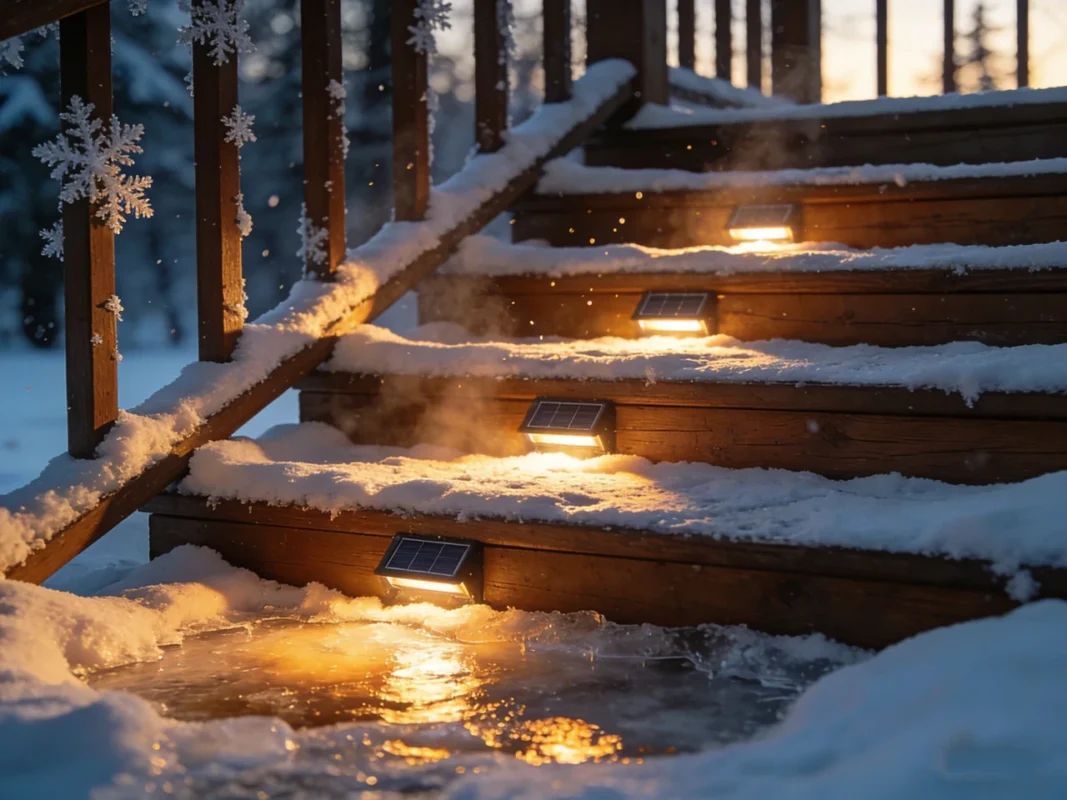
If snow covers the panel, the light won’t charge. It’s that simple.
Best winter practices:
- Gently brush snow off panels
- Avoid chipping ice with hard tools
- Ensure melting snow drains away from housing
- Check for freeze-related cracks in spring
High-quality solar safety lights for stairs should tolerate cold temperatures. However, battery runtime may shorten in winter due to reduced daylight hours.
If you’re using solar driveway marker lights near stair transitions, those may require additional clearing because they sit closer to the ground.
Monitor Light Output Consistency
Over time, LEDs rarely burn out suddenly. Instead, you’ll notice gradual dimming.
Walk your stairs periodically at night and check for:
- Uneven brightness
- Flickering
- Delayed activation
- Short runtime
Sometimes repositioning solar deck lights for stairs to capture more sunlight solves the issue. Other times, battery replacement restores full performance.
If you’re running outdoor pathway step lights alongside stair lighting, make sure brightness levels remain consistent across zones.
Seasonal Angle Adjustments (Often Overlooked)
The sun’s angle shifts throughout the year.
In summer:
- Higher sun angle
- Longer daylight hours
In winter:
- Lower sun angle
- Shorter charging window
If your solar deck lights for stairs allow panel adjustment, slightly tilt them toward the winter sun angle in late fall. That simple change can noticeably improve winter runtime.
Most homeowners never think about this — but small adjustments can extend performance dramatically.
Protect Against Physical Impact
Outdoor stairs are high-traffic areas.
Watch for:
- Foot strikes on surface-mounted fixtures
- Furniture scraping against lights
- Ice shovels hitting housings
- Pets bumping fixtures
If you frequently host gatherings, recessed led stair lights for deck may hold up better in the long run.
Durability matters just as much as brightness.
When It’s Time to Replace the Entire Fixture
Even with good maintenance, nothing lasts forever.
You may need full replacement if:
- Internal corrosion is visible
- The solar panel surface becomes cloudy
- Housing cracks repeatedly
- LED output declines permanently
Quality solar deck lights for stairs should last 4–6 years with proper care. Some longer, depending on climate.
If your lights consistently underperform despite battery replacement and cleaning, replacement may be more cost-effective than ongoing troubleshooting.
Maintenance Schedule Summary
Here’s a simple maintenance rhythm I recommend:
Monthly (during active seasons):
- Wipe solar panels
Twice per year:
- Inspect housing and seals
- Tighten mounting screws
- Check alignment
Every 2–3 years:
- Replace rechargeable batteries
After severe weather:
- Inspect for cracks
- Confirm proper operation
That’s it. No wiring inspections. No transformer adjustments. No electrical troubleshooting.
Troubleshooting Common Issues
Even the best solar lights may face occasional problems. Here’s how to handle them:
Lights Not Turning On
Check battery orientation and solar panel exposure. Insufficient sunlight is often the culprit.
Dim Illumination
Clean the panel, replace old batteries, or adjust spacing. Overcrowded lights can reduce overall brightness.
Physical Damage
Strong winds or heavy foot traffic may damage lights. Choose recessed LED stair lights for deck to minimize hazards in high-traffic areas.
Real-World Expert Tips
Having installed hundreds of lights, here’s what professionals recommend:
- Test placement before drilling: Lay out lights and check nighttime effect.
- Combine sensor and ambient lights: Motion sensors enhance safety without constant brightness.
- Check for shadows: Ensure foliage or railings don’t block solar panels.
- Rotate lights seasonally: Adjust panel angle to capture optimal sunlight.
Conclusion
Installing solar deck lights for stairs is a practical and stylish way to enhance safety and elevate your outdoor space. With options ranging from LED stair lights for deck to solar driveway marker lights, there’s a solution for every deck, pathway, or staircase. Proper planning, careful installation, and routine maintenance ensure that your solar lights perform efficiently, even through rain, snow, or long winter nights. Whether you’re a DIY enthusiast or a seasoned pro, solar stair lighting is an investment that pays off in safety, convenience, and ambiance.
Frequently Asked Questions
How do you mount solar lights on stairs?
To mount solar deck lights for stairs, position them on the stair riser (the vertical face), not the tread. Measure and mark consistent placement, drill pilot holes, and secure using exterior-grade screws. Avoid mounting too high, which can cause glare. Always ensure the solar panel faces outward and receives adequate sunlight.
For recessed led stair lights for deck, cut a properly sized opening, insert the fixture flush with the surface, and seal according to installation guidelines to maintain waterproof integrity.
Are solar deck lights waterproof?
Yes, most quality solar deck lights for stairs are designed as waterproof deck lighting and rated for outdoor use. Look for a minimum IP65 rating, which protects against rain and water spray. However, waterproof performance depends on proper installation. Overtightening screws or damaging seals can allow moisture inside.
Routine inspection helps maintain long-term weather resistance.
Do solar step lights need direct sun?
Solar step lights outdoor perform best in direct sunlight, but they do not require full-day exposure. Four to six hours of solid sun is typically enough for reliable overnight operation.
In shaded areas, choose solar safety lights for stairs with larger panels or higher battery capacity. Keep panels clean and unobstructed for maximum charging efficiency.
How many lumens for deck stairs?
For safe visibility, 20–50 lumens per fixture is ideal for solar deck lights for stairs. Lower output provides subtle ambiance, while higher output improves clarity in darker yards.
Avoid excessively bright lights, which can create glare and reduce depth perception on steps. Even, diffused light is safer than overly intense beams.
How long do solar deck lights last at night?
High-quality solar deck lights for stairs typically last 8–12 hours on a full charge. Runtime depends on sunlight exposure, battery capacity, and season.
During winter, shorter daylight hours may reduce runtime slightly. Replacing aging batteries every 2–3 years helps maintain consistent overnight performance.
Can you walk on solar deck lights?
Most surface-mounted solar deck lights for stairs are not designed to be stepped on. However, certain recessed or flush-mounted led stair lights for deck are rated for foot traffic.
Always check load specifications before installing lights in walkable areas to avoid damage or safety risks.
Do they work in snow and ice?
Yes, solar deck lights for stairs work in snow and ice, but performance depends on maintenance. Snow covering the solar panel prevents charging.
Clear snow gently with a soft brush and avoid striking the fixture with hard tools. Quality waterproof deck lighting should withstand freezing temperatures when properly sealed.
How do you replace the battery in deck lights?
To replace the battery in solar deck lights for stairs:
1. Open the battery compartment.
2. Remove the old rechargeable battery.
3. Insert a compatible replacement.
4. Reseal the housing securely.
Most batteries last 2–3 years. If lights dim or shut off early despite good sun exposure, battery replacement is usually the solution.
Do solar deck lights increase home safety?
Yes. Properly installed solar safety lights for stairs improve visibility, reduce nighttime trip hazards, and clearly define step edges. Consistent illumination is especially important for households with children, older adults, or frequent guests.
Stair lighting should be viewed as safety infrastructure — not just decoration.
Are solar deck lights worth it compared to wired lighting?
For most residential applications, solar deck lights for stairs are cost-effective and easier to install than wired systems. They require no trenching, no electrical permits, and minimal maintenance.
While wired systems may offer higher brightness, modern solar step lights outdoor provide reliable performance for typical deck and stair safety needs without ongoing energy costs.