

Table of Contents
When people talk about comfort at home, airflow is often underestimated. Temperature matters, sure—but how air moves through a space can make or break how a room feels. That’s where large fans come in. Whether you’re dealing with a tall living room, a wide-open great room, or a covered patio, large fans can transform how a space feels, looks, and functions.
This guide breaks down everything you need to know about large fans, from sizing and ceiling height to airflow power, lighting options, and outdoor performance. If you’ve ever wondered how to determine what size ceiling fan you need—or how to choose a ceiling fan that actually works—this is your roadmap.
What Are Large Fans and Why They Matter
Definition of Large Fans
In simple terms, large fans are ceiling fans with a wider blade span than standard models. Most experts consider anything 52 inches or wider to fall into the “large fan” category, with many options extending to 60, 72, or even more inches in ceiling fan width.
The ceiling fan width determines how much air the fan can move across a room. Larger blades sweep more area, creating stronger airflow without needing to spin aggressively. That’s why large fans are often quieter and more efficient than smaller, high-speed alternatives.
When Large Fans Are the Best Choice
Large fans aren’t just about size—they’re about matching airflow to space. Large fans shine in:
- Rooms with high ceilings
- Open-concept living areas
- Large bedrooms and great rooms
- Lofts and vaulted ceilings
- Covered outdoor patios
If a fan looks visually “lost” in a room, it’s probably undersized. In these cases, a powerful fan with a larger ceiling fan width offers better balance, better comfort, and better performance.
How Fan Size Impacts Airflow and Comfort
Choosing the right fan size is not just a design decision—it directly affects how a room feels, how efficiently air circulates, and how comfortable people are throughout the day. When it comes to large fans, size determines airflow reach, air velocity, noise level, and even energy efficiency. Understanding this relationship is essential, especially for open layouts and fan high ceiling spaces.
Ceiling Fan Width Explained
One of the most misunderstood concepts in ceiling fan selection is ceiling fan width. Simply put, ceiling fan width refers to the full diameter of the fan blades from tip to tip. A 52-inch fan has a blade span of 52 inches, while large fans can reach 60, 72 inches, or more.
Why does ceiling fan width matter so much? Because airflow coverage increases with blade span. A wider fan sweeps a larger circle of air, distributing airflow more evenly across the room. This is especially important in large rooms or rooms with high ceilings, where smaller fans often fail to move air beyond a limited area.
In practical terms:
- Narrow ceiling fan width = concentrated airflow, limited coverage
- Wide ceiling fan width = broad airflow, balanced comfort
That’s why large fans are typically recommended when applying fan size by room guidelines for open-plan living spaces, tall ceilings, or oversized rooms.
Why Larger Fans Move Air More Efficiently
A common myth is that faster-spinning fans cool better. In reality, large fans move more air at lower speeds, which creates a smoother, more natural airflow. This is one of the key reasons large fans are often quieter and more comfortable than smaller models.
Because of their extended blade span, large fans displace more air with each rotation. This means:
- Less turbulence
- Reduced “choppy wind” feeling
- More consistent airflow from wall to wall
This is particularly beneficial in fan high ceiling environments, where air tends to collect above head height. A powerful fan with a large ceiling fan width can pull that air down and redistribute it throughout the room, improving comfort without blasting air directly at occupants.
Fan Size, Airflow Reach, and Room Comfort
When evaluating comfort, airflow reach matters just as much as airflow strength. Smaller fans often create strong airflow directly beneath the blades but leave stagnant zones around the perimeter of the room. Large fans solve this problem by extending airflow farther outward.
This is why how to determine what size ceiling fan you need should always start with room dimensions, not aesthetics. Using proper fan size by room calculations ensures that airflow reaches seating areas, walkways, and corners—areas where people actually spend time.
For example:
- In a large living room, a small fan may cool the center but leave sofas feeling warm
- A large fan distributes air evenly, making the entire space feel cooler
The result is a room that feels balanced, not spot-cooled.
Noise Levels and Airflow Quality
Another overlooked advantage of large fans is noise reduction. Because they don’t need to spin as fast to move air, large fans typically operate more quietly. This matters in bedrooms, offices, and living areas where background noise can be distracting.
A properly sized large fan delivers:
- Gentle airflow rather than harsh gusts
- Lower operating noise
- A more relaxing environment
This combination of airflow quality and acoustic comfort is a major reason why large fans are increasingly recommended by HVAC professionals for residential use.
Energy Efficiency and Thermal Comfort
From an perspective, airflow efficiency is closely tied to energy efficiency. Large fans help maintain thermal comfort by improving air circulation, which reduces reliance on heating and cooling systems.
By keeping air in motion:
- Rooms feel cooler in summer without lowering the thermostat
- Warm air is redistributed in winter when the fan runs in reverse
This makes large fans a smart long-term investment for comfort and energy savings, particularly in homes with tall ceilings or large floor plans.
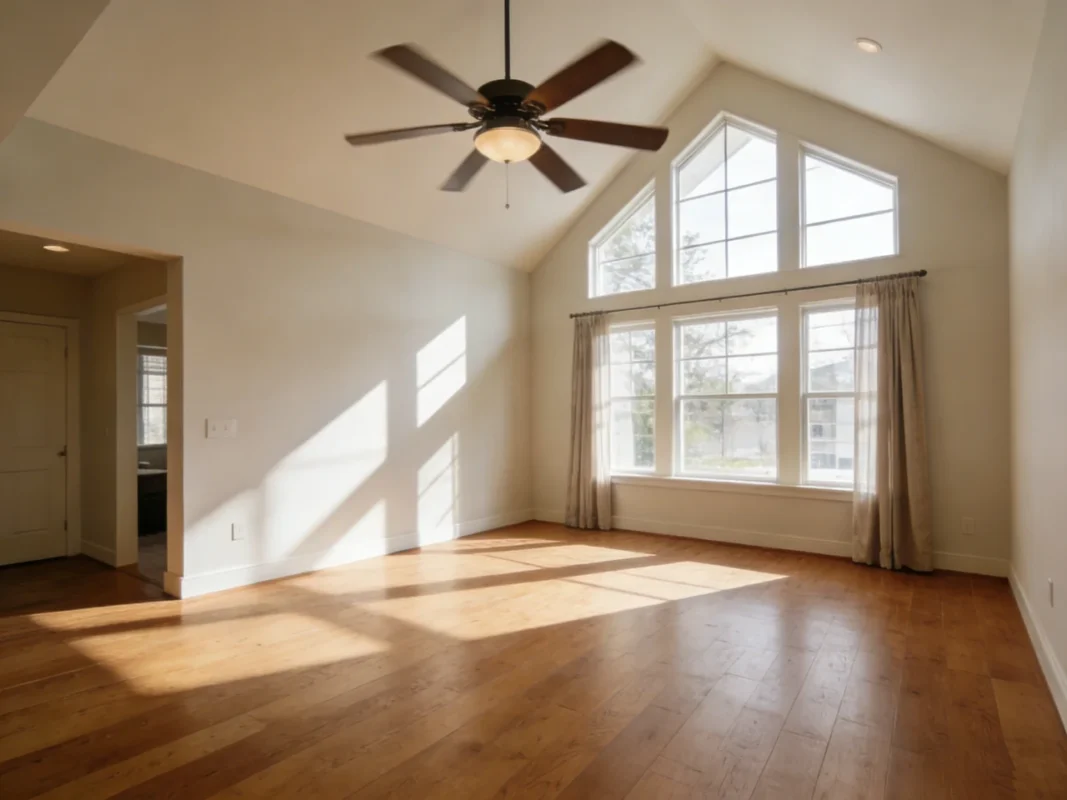
Fan Size by Room – How to Determine What Size Ceiling Fan You Need
Selecting the correct fan size is one of the most important steps in creating effective airflow. When the fan is too small, the room feels stuffy. When it’s too large, airflow can feel overpowering or uneven. Understanding how to determine what size ceiling fan you need ensures comfort, efficiency, and long-term satisfaction—especially when choosing large fans for modern homes.
Fan Size by Room Dimensions
The most reliable way to choose the right fan is to match fan size by room square footage. This method is widely recommended by building and energy-efficiency professionals because it balances airflow coverage with comfort.
Here’s a practical breakdown:
- Rooms up to 100 sq ft A fan with a ceiling fan width of 29–36 inches is usually sufficient. These are best for small bedrooms, bathrooms, or home offices.
- Rooms between 100–225 sq ft Fans with a ceiling fan width of 42–48 inches provide balanced airflow without overwhelming the space.
- Rooms between 225–400 sq ft This is where large fans truly shine. A ceiling fan width of 52–56 inches delivers consistent airflow across seating areas and walkways.
- Rooms over 400 sq ft Extra-large spaces benefit from fans 60 inches or wider, or even multiple large fans spaced evenly for optimal circulation.
Using these fan size by room guidelines helps prevent common issues like uneven cooling, stagnant corners, and unnecessary noise.
Why Ceiling Height Changes Fan Size Requirements
Room size alone isn’t enough. Ceiling height plays a major role in how air moves. In fan high ceiling rooms, air naturally rises, creating temperature layers that reduce comfort.
Higher ceilings often require:
- A larger ceiling fan width
- A stronger motor
- A downrod to position blades at the ideal height
In these cases, large fans perform better because they move air downward more effectively and distribute it across a larger vertical space.
Is a 52 Inch Ceiling Fan Too Big for a 10×12 Room?
This is one of the most common sizing questions—and the answer depends on more than square footage. A 10×12 room measures about 120 square feet, which traditionally falls into the mid-size category.
However, a 52-inch ceiling fan can work well in this space when:
- The ceiling height is above standard
- The room has limited natural airflow
- Quiet, low-speed operation is preferred
Because large fans move air efficiently at lower speeds, they often feel more comfortable than smaller fans spinning at high speed. Proper blade height and placement are key to avoiding excessive airflow.
How Room Shape Affects Fan Selection
Square footage is only part of the story. Long, narrow rooms or open layouts may require a wider ceiling fan width to ensure even airflow.
For example:
- Rectangular living rooms benefit from larger blade spans
- Open-plan spaces may need multiple large fans instead of one oversized unit
Understanding how to determine what size ceiling fan fits your layout helps eliminate hot spots and improves overall comfort.
Airflow Goals and Lifestyle Considerations
Different rooms have different airflow needs. Bedrooms typically require gentler circulation, while kitchens and living areas benefit from stronger airflow.
When selecting large fans, consider:
- How often the room is occupied
- Whether the fan will run all day or only occasionally
- Sensitivity to noise or drafts
A properly sized fan supports daily comfort without becoming a distraction.
Avoiding Common Fan Sizing Mistakes
Many homeowners choose fans based on appearance alone. This often leads to poor airflow performance. The most common mistakes include:
- Choosing a fan that’s too small for the room
- Ignoring ceiling height in fan high ceiling spaces
- Overlooking airflow reach beyond the center of the room
By following proven fan size by room principles and focusing on airflow rather than looks alone, you ensure your fan performs exactly as intended.
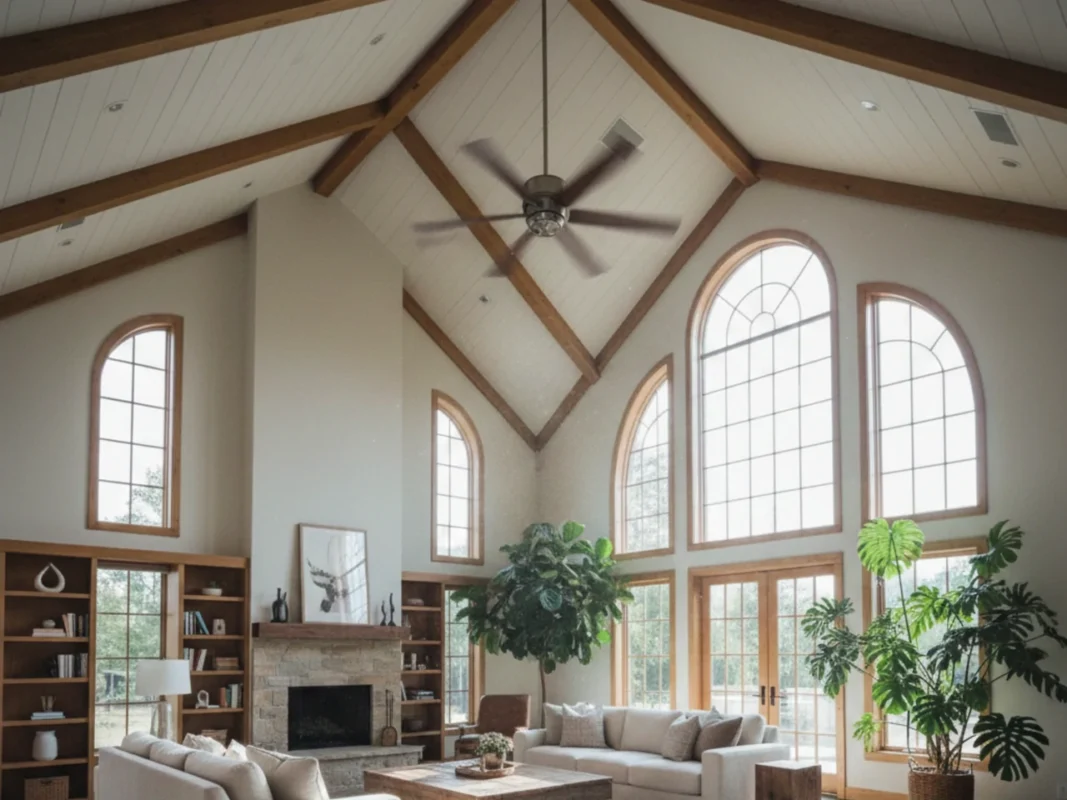
Fan High Ceiling Solutions
Rooms with tall ceilings are visually impressive, but they present unique airflow challenges. Warm air rises, cool air stays low, and without proper circulation, comfort quickly suffers. That’s why choosing the right fan high ceiling solution is critical. In these spaces, standard fans often fall short, while large fans are specifically designed to move air vertically and horizontally where it’s needed most.
What Type of Ceiling Fan Is Best for High Ceilings?
The best ceiling fan for high ceilings is one that combines size, power, and correct mounting. In fan high ceiling environments, airflow must travel farther, which means the fan needs to work smarter—not faster.
Key characteristics include:
- Large ceiling fan width Wider blades move more air per rotation, allowing the fan to circulate air across large vertical spaces without excessive speed.
- Strong, efficient motor A truly powerful fan delivers consistent airflow at lower speeds, which improves comfort and reduces noise.
- Downrod mounting High ceilings require downrods to position the fan at the ideal height, typically 8–9 feet above the floor. This ensures airflow actually reaches occupants instead of staying near the ceiling.
- Stable blade design In tall rooms, stability matters. Larger blades with proper balance reduce wobble and maintain smooth operation.
When these elements work together, large fans excel at breaking up heat stratification and improving overall air circulation in high spaces.
Is 10 ft Too High for a Ceiling Fan?
A 10-foot ceiling is not too high for a ceiling fan, but it does require thoughtful installation. Without a downrod, a fan mounted directly to a 10-foot ceiling will sit too high to circulate air effectively.
For best performance:
- The bottom of the blades should be at least 7 feet above the floor for safety
- Optimal airflow occurs when blades are positioned 8–9 feet above the floor
- Downrods help lower the fan into the airflow zone
In fan high ceiling rooms, even a small difference in blade height can significantly affect comfort. Large fans paired with the correct downrod length deliver noticeably better results than smaller fans mounted too close to the ceiling.
Why Large Fans Perform Better in Tall Spaces
High ceilings increase the volume of air in a room. Small fans simply don’t move enough air to keep that volume circulating. Large fans solve this problem by creating wide, slow-moving air patterns that push air downward and outward at the same time.
This dual-direction airflow:
- Pulls warm air down from the ceiling
- Redistributes cooler air throughout the room
- Prevents stagnant air pockets
A powerful fan with a wide ceiling fan width ensures that air reaches seating areas, walkways, and corners—even in rooms with vaulted or cathedral ceilings.
Ceiling Height, Blade Height, and Comfort
Comfort in high-ceiling rooms depends less on speed and more on positioning. A fan mounted too high may spin aggressively without delivering meaningful airflow at occupant level.
Proper fan high ceiling setup focuses on:
- Matching fan size to ceiling height
- Using appropriate downrod lengths
- Avoiding flush mounts in tall rooms
When blade height is optimized, large fans create gentle, consistent airflow that feels natural rather than forceful.
Using Fan Direction to Improve Year-Round Comfort
Fan direction plays an important role in fan high ceiling performance. During warmer months, fans should rotate counterclockwise to push air downward, creating a cooling effect. In cooler months, reversing the direction helps pull air upward and redistribute warm air that collects near the ceiling.
In tall rooms, this seasonal adjustment makes a noticeable difference in comfort and energy efficiency, especially when paired with large fans designed for continuous operation.
How to Cool a Room with a High Ceiling
Using Large Fans to Improve Air Circulation
High ceilings trap warm air. That’s physics. Large fans help by pushing air downward, breaking up temperature layers and redistributing cooler air.
In summer, set your large fans to rotate counterclockwise. This pushes air straight down, creating a wind-chill effect that makes the room feel cooler without changing the thermostat.
Ceiling Fans vs. Air Conditioning in High Spaces
Large fans don’t replace air conditioning—but they make it work smarter. With effective airflow, you can raise the thermostat a few degrees and still feel comfortable. That means lower energy bills and less strain on your system.
Powerful Fan Performance – What Really Matters
When shopping for ceiling fans, many people focus on appearance first and performance second. But in practice, airflow performance is what determines whether a fan actually improves comfort. A powerful fan isn’t defined by noise or speed—it’s defined by how efficiently it moves air through a space. This distinction is especially important when selecting large fans for big rooms or fan high ceiling environments.
Understanding CFM Ratings
One of the most reliable ways to evaluate fan performance is by looking at CFM, or cubic feet per minute. CFM measures how much air a fan moves, not how fast it spins. Higher CFM generally means stronger airflow, but it must be balanced with fan size and placement.
As a general guideline:
- Small rooms often need moderate CFM levels
- Large rooms and high ceilings require significantly higher CFM
- Open spaces benefit from wide airflow distribution rather than focused airflow
Large fans naturally deliver higher CFM because their increased ceiling fan width allows them to move more air with each rotation. This makes them more effective at maintaining comfort without creating harsh air currents.
Why Fan Size and CFM Must Work Together
CFM alone doesn’t tell the whole story. A small fan spinning quickly may produce a high CFM number, but that airflow is often concentrated in a narrow area. In contrast, large fans distribute airflow across a wider area, making the air movement feel smoother and more natural.
This is why understanding how to determine what size ceiling fan you need is essential when evaluating powerful fan performance. When fan size and CFM are properly matched to the room, airflow reaches where people actually sit and move.
In fan high ceiling spaces, this balance becomes even more important. Air must travel vertically and horizontally, which requires both sufficient airflow volume and proper blade span.
Motor Strength and Airflow Consistency
A truly powerful fan delivers consistent airflow across all speed settings. Motor strength affects how smoothly the fan operates, how quietly it runs, and how well it maintains airflow over time.
High-quality motors provide:
- Stable rotation at low speeds
- Reduced vibration
- Reliable performance under continuous use
In large fans, motor efficiency allows the fan to maintain airflow without relying on high-speed operation, which improves both comfort and longevity.
Blade Design and Pitch Impact Performance
Blade pitch—the angle of the blades—plays a crucial role in how air is moved. A well-designed blade pitch allows the fan to scoop and push air efficiently rather than simply stirring it.
When combined with a wide ceiling fan width, proper blade pitch enhances:
- Downward airflow in summer
- Upward air redistribution in winter
- Overall circulation in tall rooms
This is particularly beneficial in fan high ceiling spaces, where air stratification can reduce comfort if airflow isn’t strong and well-directed.
Noise Levels and Comfort Perception
Many people equate power with loud operation, but the opposite is often true. Large fans with strong motors typically operate more quietly because they don’t need to spin at extreme speeds to move air.
A powerful fan should produce:
- Smooth, consistent airflow
- Minimal mechanical noise
- No distracting vibrations
Quiet performance is especially valuable in bedrooms, living rooms, and workspaces where comfort goes beyond temperature alone.
Energy Efficiency and Long-Term Reliability
From an EEAT perspective, performance must be sustainable. Powerful fan performance isn’t just about immediate airflow—it’s about long-term efficiency and reliability.
Large fans help reduce energy consumption by:
- Allowing higher thermostat settings in summer
- Improving heat distribution in winter
- Reducing reliance on constant HVAC use
When airflow is efficient, comfort improves without increased energy costs.
Power Isn’t About Speed—It’s About Control
The biggest misconception about powerful fan performance is that faster is better. In reality, effective airflow comes from controlled, well-distributed air movement. Large fans excel here, offering broad coverage, steady circulation, and reliable comfort.
When evaluating a powerful fan, focus on how it moves air, how evenly that air is distributed, and how quietly it operates. In well-designed spaces, large fans don’t just move air—they redefine comfort.

Fan Lights – Combining Airflow and Illumination
In many homes, a ceiling fan does more than move air—it also serves as a primary light source. Fan lights combine two essential functions into one fixture, making them especially useful in rooms where space, ceiling height, or layout limits lighting options. When paired with large fans, integrated lighting can enhance both comfort and visibility without cluttering the ceiling.
When to Choose Fans with Lights
Fans with built-in lighting are a smart choice when a room lacks overhead fixtures or needs layered lighting without additional installations. Fan lights are commonly used in bedrooms, living rooms, kitchens, and even covered outdoor spaces.
They are particularly beneficial in:
- Rooms with limited ceiling space
- Open-plan areas where one fixture must serve multiple functions
- Spaces where balanced airflow and lighting are equally important
In fan high ceiling rooms, fan lights also help visually anchor the fan, making large fans feel intentional rather than oversized.
How Fan Lights Affect Airflow Performance
A common concern is whether fan lights interfere with airflow. When properly designed, they do not. High-quality fan lights are integrated into the center housing, allowing blades to move air freely without obstruction.
In fact, large fans often handle lighting additions better than smaller fans because their ceiling fan width distributes airflow outward rather than relying on a narrow downward stream. This means airflow remains smooth and effective, even with lighting installed.
Types of Fan Lights Available
Fan lights come in several styles, each suited to different needs:
- Integrated lighting Built directly into the fan housing, these provide a clean, modern look and consistent illumination.
- Replaceable light fixtures These allow for bulb changes and offer flexibility in brightness and color temperature.
- Dimmable fan lights Ideal for living rooms and bedrooms, dimmable options allow users to adjust light levels without affecting fan speed.
Choosing the right type of fan lights ensures the fan remains functional without overpowering the room visually.
Fan Lights and Room Size Considerations
Lighting needs often increase with room size. In larger spaces, a small central light may not provide adequate illumination. Large fans with fan lights help distribute light across a wider area, reducing shadows and dark corners.
For rooms following fan size by room guidelines, lighting output should scale with fan size. Larger fans typically pair best with brighter or adjustable fan lights to match the room’s proportions.
Using Fan Lights in High-Ceiling Spaces
In rooms with tall ceilings, lighting placement becomes more challenging. Ceiling-mounted fixtures may sit too high to provide effective illumination. Fan lights help bridge this gap by positioning light slightly lower, closer to the living space.
When used in fan high ceiling applications:
- Downrods lower both the fan and light to a functional height
- Light spreads more evenly across the room
- The space feels warmer and more inviting
This makes fan lights especially useful in vaulted ceilings and open living areas.
Energy Efficiency and Lighting Integration
Modern fan lights are designed to work efficiently alongside airflow systems. Energy-efficient lighting reduces heat output, which helps maintain cooling performance during warmer months.
By combining airflow and illumination in one unit, fan lights:
- Reduce the need for additional fixtures
- Simplify ceiling layouts
- Improve overall energy efficiency
This dual-function approach aligns well with long-term comfort and energy-conscious living.
Outdoor Fans with Lighting – What You Need to Know
Outdoor living spaces are no longer an afterthought. Covered patios, porches, and semi-enclosed areas are now extensions of the home, and comfort matters just as much outside as it does indoors. Outdoor fans with lighting play a key role in making these spaces usable day and night, especially in warm climates where airflow is essential. When properly selected, large fans designed for outdoor use deliver steady airflow, reliable lighting, and long-term durability.
What Type of Fan Is Best for an Outdoor Patio?
The best fan for an outdoor patio is one specifically designed to handle moisture, humidity, and temperature changes. Unlike indoor environments, outdoor spaces expose fans to elements that can affect both airflow and lighting performance.
An ideal outdoor fan should feature:
- Materials resistant to moisture and corrosion
- Sealed motor components
- Stable blade construction to handle airflow changes
In larger patios or open-air structures, large fans provide broader airflow coverage, ensuring that air reaches seating areas rather than staying concentrated in the center.
Why Large Fans Work Better Outdoors
Outdoor spaces tend to be wider and less enclosed, which allows air to escape more easily. Smaller fans often struggle to create noticeable airflow in these conditions. Large fans, with their wider ceiling fan width, move more air per rotation and maintain a consistent breeze across a larger area.
This makes them particularly effective for:
- Covered patios
- Pergolas
- Outdoor dining areas
- Poolside seating spaces
A powerful fan is essential outdoors, where natural air currents and heat can overpower weaker airflow systems.
The Role of Lighting in Outdoor Fans
Lighting is just as important as airflow in outdoor spaces. Outdoor fans with lighting extend usability into the evening and improve safety by illuminating walkways and seating areas.
Well-designed outdoor fan lights:
- Are sealed against moisture
- Provide even, glare-free illumination
- Sit securely within the fan housing
When paired with large fans, lighting feels more balanced and proportional, preventing the fixture from looking undersized in open areas.
Choosing the Right Lighting Output
Outdoor spaces typically require brighter lighting than indoor rooms due to ambient darkness and surrounding open areas. When selecting outdoor fans with lighting, consider how the space will be used.
For example:
- Dining areas benefit from brighter, focused light
- Lounge spaces often prefer softer, diffused illumination
- Multi-purpose patios may require adjustable lighting levels
Matching lighting output with fan size ensures both airflow and illumination feel intentional and comfortable.
Ceiling Height and Mounting Considerations Outdoors
Ceiling height still matters outside. In covered patios or pavilions, the same principles apply as indoor fan high ceiling setups. Blades should be positioned low enough to deliver airflow but high enough to remain safe.
Downrods are often necessary to:
- Improve airflow reach
- Position lighting closer to usable space
- Prevent air from dispersing too high
In outdoor installations, correct mounting height significantly improves both cooling effectiveness and lighting usability.
Energy Efficiency and Long-Term Use
Outdoor fans often run for long periods during warm seasons. Energy-efficient motors and lighting reduce operating costs while maintaining comfort.
Large fans with efficient airflow patterns:
- Cool larger areas using less energy
- Reduce reliance on outdoor cooling appliances
- Provide consistent performance over time
When airflow and lighting work together, outdoor spaces become more comfortable without excessive energy use.
Common Outdoor Fan Mistakes to Avoid
The most common mistakes include:
- Using indoor-rated fans outdoors
- Choosing fans that are too small for the space
- Ignoring lighting needs after sunset
Avoiding these issues ensures outdoor fans with lighting remain safe, effective, and enjoyable.
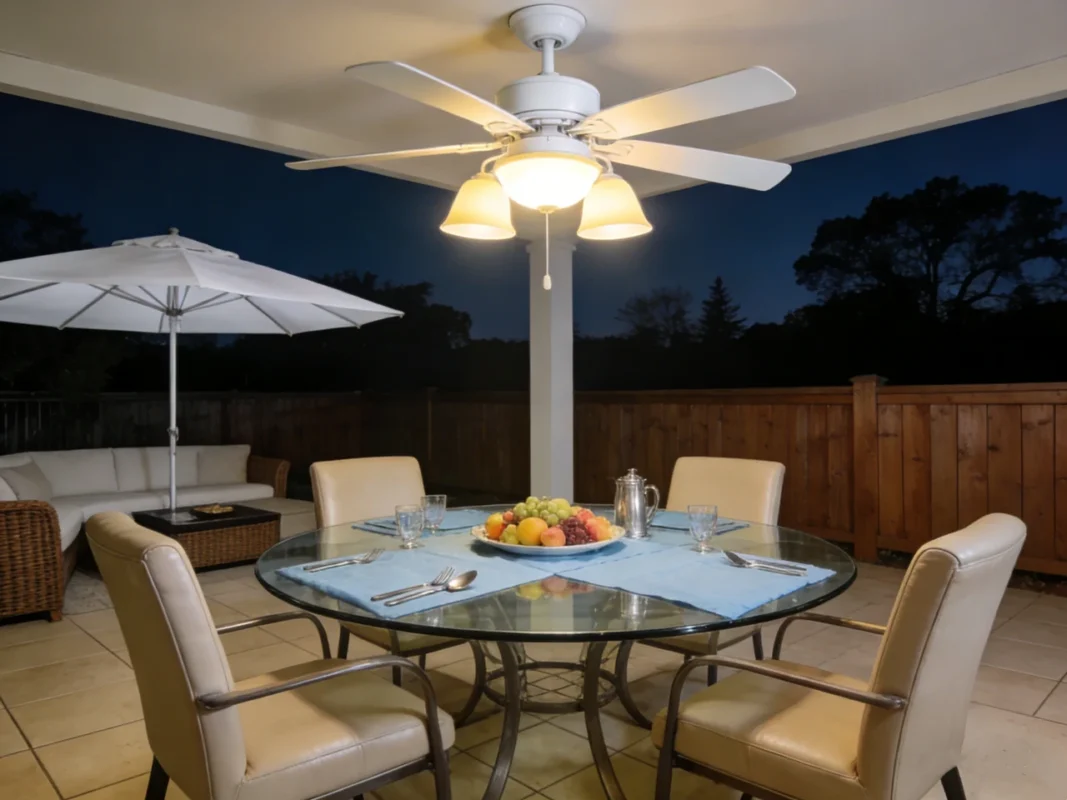
Installation Height and Safety Guidelines
Even the best ceiling fan won’t perform well if it’s installed incorrectly. Installation height plays a critical role in airflow efficiency, safety, and overall comfort. This is especially true when installing large fans in rooms with tall ceilings or open layouts. Following proper installation height and safety guidelines ensures that airflow reaches the living zone while keeping the fan secure and compliant with common safety standards.
Optimal Ceiling Fan Height
For both comfort and safety, ceiling fan blades should be positioned at the right distance from the floor. The generally accepted guidelines are:
- Minimum blade height: 7 feet above the floor
- Ideal blade height: 8–9 feet above the floor
- Minimum clearance from ceiling: 8–10 inches
In rooms with standard ceilings, this often happens naturally. However, in fan high ceiling rooms, achieving this ideal height usually requires a downrod.
When blades are mounted too high, airflow stays near the ceiling and fails to cool the occupied space. Large fans perform best when positioned within the active airflow zone, where air movement can be felt without being overpowering.
Why Downrods Matter for Large Fans
Downrods are not just accessories—they are essential for proper airflow in tall rooms. Without a downrod, even a powerful fan may struggle to circulate air effectively.
Downrods help:
- Lower large fans to the correct operating height
- Improve airflow reach across the room
- Reduce wasted air movement near the ceiling
In spaces with vaulted or cathedral ceilings, adjustable downrods allow the fan to hang level, which improves stability and airflow balance.
Safety Clearances and Room Layout
Safety is just as important as comfort. In addition to vertical height, horizontal clearances matter as well.
For safe operation:
- Blades should be at least 18 inches from walls
- Furniture should not sit directly beneath low-mounted fans
- Walkways should remain clear of blade sweep
Large fans have wider blade spans, so proper spacing is critical to avoid airflow obstruction and ensure safe use.
Ceiling Structure and Mounting Stability
Large fans are heavier than smaller models and place more stress on mounting hardware. The ceiling structure must be able to support the fan’s weight and motion.
Proper installation includes:
- Using a ceiling-rated electrical box
- Securing mounting brackets directly to structural support
- Ensuring all fasteners are tightly secured
This is particularly important in fan high ceiling installations, where leverage increases due to longer downrods.
Avoiding Common Installation Mistakes
Many performance issues come from installation errors rather than fan quality. The most common mistakes include:
- Mounting large fans too close to the ceiling
- Using a downrod that is too short or too long
- Ignoring room proportions and airflow patterns
These errors reduce airflow effectiveness and can cause unnecessary noise or wobble.
Balancing Safety and Performance
A well-installed fan should feel stable, quiet, and effective. When height and spacing are correct, large fans deliver smooth airflow without creating discomfort or safety concerns.
In well-planned installations, the fan becomes part of the room’s function rather than a distraction. By following proper installation height and safety guidelines, large fans perform as intended—delivering comfort, efficiency, and peace of mind for years to come.
Maintenance Tips for Large and Powerful Fans
Regular maintenance is essential for keeping ceiling fans operating efficiently and safely. Because large fans move more air and often run for longer periods, proper care plays a direct role in performance, comfort, and lifespan. A well-maintained powerful fan delivers smoother airflow, quieter operation, and more consistent comfort—especially in rooms with high ceilings.
Cleaning Blades for Optimal Airflow
Dust and debris naturally collect on fan blades over time. On large fans, this buildup can noticeably reduce airflow and create uneven air movement.
Best practices for cleaning include:
- Wiping blades every 1–2 months in frequently used rooms
- Using a damp cloth to trap dust rather than spreading it
- Cleaning both the top and bottom surfaces of each blade
In fan high ceiling rooms, dust buildup often goes unnoticed but has a bigger impact due to blade size. Clean blades allow large fans to move air efficiently without extra strain on the motor.
Maintaining Balance and Stability
Large fans rely on precise balance to operate smoothly. Even minor imbalances can cause wobbling, noise, or reduced airflow.
To maintain stability:
- Check blade alignment periodically
- Tighten mounting screws and blade fasteners
- Ensure blades are evenly spaced
If a powerful fan begins to wobble, addressing the issue early prevents long-term wear on the motor and mounting system.
Motor Care and Long-Term Performance
The motor is the heart of any ceiling fan. While most modern motors are designed for minimal maintenance, regular inspection helps ensure reliable operation.
Motor care tips:
- Listen for unusual sounds during operation
- Ensure ventilation openings remain unobstructed
- Avoid running the fan at maximum speed unnecessarily
Large fans are built for efficiency, and consistent low-to-medium speed operation helps extend motor life while maintaining comfort.
Seasonal Direction Adjustments
Changing the fan’s rotation direction is a simple but often overlooked maintenance step. In warmer months, counterclockwise rotation pushes air downward, creating a cooling effect. In cooler months, reversing the direction pulls air upward and redistributes warm air trapped near the ceiling.
This seasonal adjustment is especially important in fan high ceiling spaces, where heat stratification can reduce comfort if airflow direction is incorrect.
Lighting Maintenance for Fans with Lights
For fans equipped with lighting, maintaining illumination is just as important as maintaining airflow.
Tips for fan lights include:
- Cleaning light covers to maintain brightness
- Ensuring fixtures remain secure
- Checking for flickering or uneven lighting
Proper maintenance ensures fan lights continue to complement airflow rather than becoming a distraction.
Outdoor Fan Maintenance Considerations
Outdoor large fans require additional attention due to exposure to moisture and temperature changes.
Recommended care includes:
- Periodic inspection for corrosion
- Cleaning blades to remove debris and pollen
- Ensuring lighting components remain sealed
Consistent maintenance protects both airflow performance and lighting reliability in outdoor environments.
Frequently Asked Questions
What type of ceiling fan is best for high ceilings?
For rooms with high ceilings, large fans with long downrods are ideal. They ensure proper airflow by bringing the fan closer to the living space. Look for models specifically designed as a fan high ceiling solution, which often feature larger blade spans and higher-powered motors to circulate air effectively throughout the room.
Is 10 ft too high for a ceiling fan?
A 10-foot ceiling is not too high for a ceiling fan, but you will likely need a longer downrod to position the fan at an optimal height for airflow. Using large fans with adjustable rod lengths helps maintain efficiency and comfort without compromising room aesthetics.
How to cool a room with a high ceiling?
To cool a room with a high ceiling, choose large fans with wide blades and powerful motors. Position the fan at a lower point using a downrod, and ensure the fan operates at higher speeds for maximum air circulation. Additionally, pairing ceiling fans with fan lights can help maintain functional lighting while optimizing airflow.
What is the width of a ceiling fan?
The width of a ceiling fan, often referred to as blade span, typically ranges from 36 inches to 60 inches or more. Ceiling fan width is crucial in determining coverage: larger rooms require wider fans to ensure air reaches every corner efficiently. Large fans with blade spans over 52 inches are suitable for spacious areas and high ceilings.
Is a 52-inch ceiling fan too big for a 10×12 room?
Yes, a 52-inch fan may be oversized for a 10×12 room. Fan size by room is essential: small rooms (up to 75 sq. ft.) typically need fans 36–42 inches wide. Oversized fans in small spaces can create excessive airflow and noise, so always match fan width to room dimensions for comfort and efficiency.
What type of fan is best for an outdoor patio?
For outdoor areas, choose outdoor fans with lighting that are rated for damp or wet conditions. Large fans with corrosion-resistant materials and wider blade spans provide better airflow. Combining powerful fan performance with integrated lighting ensures the patio remains comfortable and well-lit, even during evenings or gatherings.
What should I consider when buying a ceiling fan?
When buying a ceiling fan, consider blade span, motor power, ceiling height, and whether it includes fan lights. Assess how to choose a ceiling fan based on room size, intended use (indoor vs. outdoor), and airflow efficiency. Large fans with high-quality motors and adjustable speed settings provide long-term comfort and energy savings.
How to determine what size ceiling fan I need?
To determine fan size, measure the room dimensions and calculate the recommended fan size by room. Large rooms benefit from fans 52–60 inches or more, while smaller rooms require 36–44 inch models. Also, consider ceiling fan width relative to furniture placement to maximize airflow without obstruction.
Can large fans reduce energy costs?
Yes, large fans improve air circulation, allowing you to rely less on air conditioning. A well-sized fan creates a wind-chill effect, making the room feel cooler and reducing HVAC usage. Selecting powerful fan models for high ceilings or spacious rooms enhances energy efficiency even further.
Are ceiling fans with lights less efficient than without?
Modern fan lights are designed to be energy-efficient, using LED technology to minimize power consumption. While they add illumination, properly designed large fans maintain excellent airflow, ensuring you get both comfort and lighting without compromising energy performance.