

Table of Contents
Welcome to your ultimate deep dive on hexagon lights garage systems. If you’ve landed here, you’re probably wondering whether those futuristic, honeycomb-pattern LED grids are just showroom flair—or a real upgrade for your workspace or garage. In this article, we’ll walk through everything: what hexagon garage lighting is, why many detailers swear by it, how to plan and install, cost and return on investment, maintenance tips, and crucial FAQs. Stick with me—you’ll finish with real confidence to decide whether hexagon shop lights or hex garage lights make sense for your space.
What Are Hexagon Garage Lights? (Definition & Basics)
If you’ve scrolled through social media or stepped into a high-end detailing shop lately, you’ve probably noticed a striking geometric pattern glowing from the ceiling — bright, interconnected hexagons illuminating every corner of the space. Those are hexagon garage lights, also known as honeycomb lights garage or hex garage lights, and they’re more than just a design trend. These modular LED systems are transforming how we light garages, workshops, and commercial spaces by delivering powerful, uniform illumination with an unmistakable modern edge.
At their core, hexagon garage lighting systems are made up of multiple LED light bars arranged into hexagonal (six-sided) patterns. The result is a network of evenly distributed light sources that eliminate shadows, increase visibility, and make any space feel more open and professional. But beyond their aesthetics, these systems are engineered for performance — combining high lumen output, accurate color rendering, and energy efficiency to outperform traditional shop lights in nearly every category.
In short, hexagon lights garage setups blend function and form: they provide the intense, shadow-free light needed for precision work while doubling as an architectural feature that elevates the space. Whether you’re a DIY car enthusiast, a professional detailer, or someone simply looking to upgrade their workspace, understanding how these lights work — and why they’re different — is the first step toward making an informed investment.
Hexagon / Honeycomb Lighting Design Explained
The key to hexagon garage lighting lies in its geometry. Traditional garage lights — whether fluorescent tubes, linear LEDs, or single overhead fixtures — cast light from a single direction, often leaving dark corners, harsh shadows, and uneven coverage. Hexagon lights take a radically different approach.
Each lighting system consists of multiple slim LED bars that connect at 120° angles to form hexagonal or honeycomb-shaped cells. These cells are then linked together into a larger grid that spans across the ceiling. Because the light comes from many points and angles, it spreads more evenly throughout the space. This multi-directional lighting drastically reduces shadows, improves depth perception, and illuminates even the most hard-to-reach areas of a garage.
This honeycomb design also has a visual advantage. Honeycomb lights garage systems have become popular not only in workshops but also in car showrooms, retail stores, and creative studios because they look futuristic and high-end. The clean geometry and glowing outlines create an architectural statement that elevates the space far beyond basic utility lighting.
Moreover, modularity is a major selling point. Most hex garage lights kits allow you to customize the number of hex cells, their arrangement, and how they integrate with other lighting types. Want a dramatic ceiling centerpiece? Go for a full honeycomb grid. Need targeted lighting over workbenches? Install a partial pattern where it’s needed most. This level of flexibility is what makes hexagon shop lights so versatile across different settings.
Key Technical Specs (Lumen, CRI, Color Temperature, Beam Angle)
To truly appreciate the performance of hexagon lights garage systems, it’s worth diving into their core specifications — the numbers that determine how they perform in real-world use. While different brands and kits vary, these are the specs that matter most:
- LumenOutput – Total Brightness Lumen output tells you how much visible light the system produces. Basic kits can start around 10,000 lumens, while advanced systems often exceed 40,000 or even 50,000 lumens. A higher lumen count means a brighter workspace, crucial for garages where detailed work like painting, polishing, or mechanical repairs takes place.
- CRI (Color Rendering Index) – Color Accuracy The CRI measures how accurately light reveals colors compared to natural daylight. A CRI above 80 is good; above 90 is excellent. High-CRI hexagon garage lighting ensures you see the true color of paints, finishes, and surfaces — essential for detailing and paint correction.
- Color Temperature – Light Tone Measured in Kelvin (K), color temperature influences the “feel” and functionality of your lighting. Most hexagon shop lights operate between 5000K and 6500K, producing a bright, daylight-like white light. This is ideal for reducing eye strain and spotting surface imperfections.
- Beam Angle & Light Distribution – Shadow Control One of the biggest advantages of honeycomb lights garage systems is their wide and even beam distribution. Because the modules are spread across the ceiling and angled differently, they eliminate hot spots and drastically reduce shadows. The result is smooth, consistent illumination across walls, floors, and vehicles.
- Energy Efficiency & Voltage Range Despite their brightness, hex garage lights are highly energy-efficient thanks to LED technology. They typically run on standard household voltage (100–240V) and consume far less electricity than fluorescent or HID fixtures while producing significantly more light per watt.
These technical qualities combine to create lighting that isn’t just bright — it’s precise, efficient, and purpose-built for demanding workspaces.
Typical Use Cases & Applications
While the term hexagon lights garage suggests they’re mainly for garages, their versatility makes them suitable for far more than just parking spaces. Here are the most common applications where these systems shine:
- Home Garages and Workshops For DIYers, mechanics, and car enthusiasts, upgrading to hexagon garage lighting is a game-changer. You get bright, shadow-free light that makes repairs, detailing, and organization easier. Plus, the futuristic aesthetic adds a premium look to your personal workspace.
- Professional Detailing and Auto Shops Perhaps the most popular use case. Auto detailers and paint correction specialists rely on hexagon shop lights because they reveal swirl marks, dust particles, and micro-defects that other lights miss. Their even light coverage reduces mistakes and improves finish quality.
- Car Showrooms and Dealerships The striking design of honeycomb lights garage systems turns a ceiling into a visual feature, making cars look their best under showroom lighting. The high-CRI light also ensures vehicle colors appear vibrant and accurate.
- Creative Studios and Workshops Artists, photographers, and content creators appreciate hex garage lights for their consistent, diffuse light. Whether filming product videos or painting large canvases, the reduction of harsh shadows is a significant advantage.
- Retail and Commercial Spaces Beyond garages, hex lighting systems are increasingly used in modern retail stores, gyms, and exhibition spaces. Their combination of form and function enhances visibility while contributing to the overall design aesthetic.
From the smallest home workshop to the most advanced detailing facility, hexagon lights garage solutions offer the performance, flexibility, and style needed to elevate any environment. Their ability to provide precise, shadow-free illumination makes them more than just a lighting upgrade — they’re a workspace transformation.

Benefits & Drawbacks of Hexagon Garage Lighting
When deciding whether to upgrade to hexagon lights garage systems, it’s important to look beyond the hype and evaluate the real-world pros and cons. These lighting solutions have earned a strong reputation among automotive professionals, DIY enthusiasts, and even commercial space designers — but like any technology, they come with both advantages and trade-offs. Understanding these can help you make a more informed decision about whether hexagon garage lighting is right for your space.
Benefits / Advantages
- Exceptional Illumination and Visibility
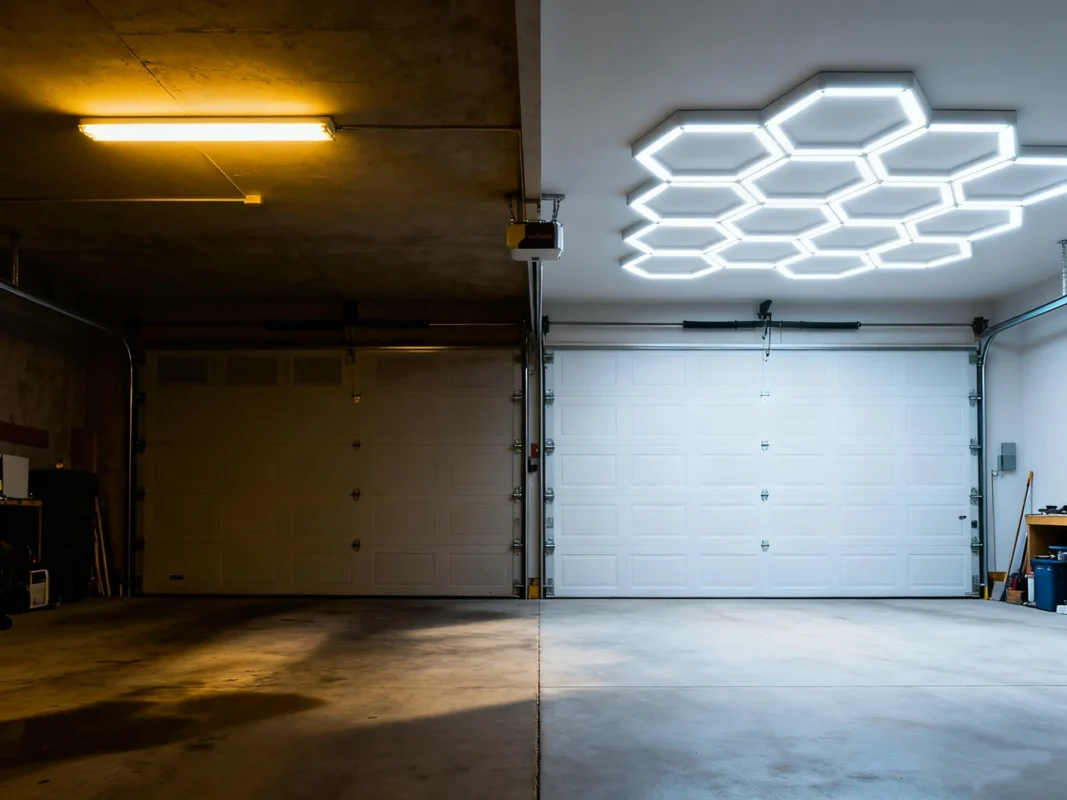
The primary reason people choose hexagon garage lighting is the dramatic improvement in visibility. Unlike traditional fluorescent tubes or single-bulb fixtures that create uneven light and deep shadows, hexagon shop lights distribute light evenly across the entire space. The honeycomb arrangement ensures that light reaches every corner, significantly reducing blind spots and improving safety. Whether you’re detailing a car, working on machinery, or just navigating your garage, the difference is night and day.
- Shadow-Free Lighting for Precision Work
Because the LEDs are positioned in multiple hexagonal cells, light comes from various angles, virtually eliminating shadows. This makes honeycomb lights garage particularly valuable in environments where precision is crucial — like automotive detailing, painting, and polishing. Professionals appreciate how these lights reveal imperfections such as swirl marks, dust nibs, or paint inconsistencies that would otherwise go unnoticed under traditional lighting.
- Aesthetic Appeal and Modern Design
Let’s be honest: hexagon lights garage setups look incredible. The geometric honeycomb pattern gives any space a futuristic, high-end vibe. For many homeowners and shop owners, the visual upgrade alone is worth the investment. It’s no wonder that high-end car showrooms, gyms, and creative studios are increasingly adopting hex garage lights not just for their functionality but also as a design statement.
- Energy Efficiency and Cost Savings Over Time
Despite their impressive brightness, hexagon shop lights are built with energy-efficient LED technology. They consume significantly less electricity than traditional fluorescent or halogen lighting while producing more lumens per watt. Over time, this translates to lower energy bills and a reduced carbon footprint — a win for both your wallet and the environment.
- Long Lifespan and Minimal Maintenance
Most high-quality hexagon garage lighting systems boast lifespans of 50,000 hours or more. That means fewer bulb replacements, less maintenance, and lower overall operating costs. Once installed, these lights require little attention beyond occasional cleaning — a major advantage for busy shops or home garages.
- Customizable and Scalable Layouts
The modular design of honeycomb lights garage systems makes them incredibly versatile. You can start with a small configuration and expand it later, or design a full-ceiling grid tailored to your space. Many kits offer plug-and-play connections, making reconfiguration simple if your needs change.
- Boosted Productivity and Better Work Quality
Improved visibility isn’t just about convenience — it has a direct impact on productivity and results. Detailers, painters, and technicians often find that hex garage lights allow them to work faster and with greater accuracy. Fewer mistakes and reworks mean better outcomes and happier clients.
- Increased Property and Resale Value
Installing hexagon lights garage isn’t just a functional upgrade; it’s also an investment in your property. A well-lit, visually appealing garage or workshop can make your home more attractive to buyers and help your business stand out from competitors.
Potential Drawbacks / Trade-offs
While hexagon garage lighting offers a long list of advantages, it’s important to consider the potential downsides before committing. Here are a few factors worth weighing:
- Higher Upfront Cost
One of the biggest obstacles for many buyers is the initial investment. Quality hexagon shop lights are significantly more expensive than basic LED tubes or traditional fluorescent fixtures. While their long-term efficiency and durability can offset the cost, the upfront price can be prohibitive for some homeowners or small businesses.
- More Complex Installation
Although many hex garage lights kits are designed for DIY installation, setting them up isn’t as simple as screwing in a lightbulb. The modular nature of honeycomb lighting requires careful planning to achieve proper alignment and coverage. Hardwiring the system may also require basic electrical knowledge — and in some cases, professional installation is recommended, which adds to the cost.
- Potential Overkill for Small Spaces
In compact garages or storage areas, a full hexagon garage lighting grid may be more than you need. In fact, over-lighting a small space can lead to unnecessary glare or wasted energy. In such cases, a smaller hex system or a combination of standard lights and a partial honeycomb setup might be a better choice.
- Heat Management Considerations
LEDs generate less heat than traditional lighting, but high-output honeycomb lights garage arrays can still produce noticeable warmth, especially in enclosed spaces. Adequate ventilation and ceiling clearance are essential to prevent heat buildup and extend the lifespan of the system.
- Style May Not Suit Every Environment
While the futuristic look of hexagon lights garage appeals to many, it may not align with every aesthetic. For example, a classic workshop or rustic garage design might clash with the sleek honeycomb pattern. In these cases, traditional or hybrid lighting options might better complement the space.
- Maintenance and Replacement Costs for Premium Systems
Although maintenance needs are minimal, when components do fail — such as connectors, drivers, or LED bars — replacements can be more expensive than standard bulbs. Choosing a reputable brand with good warranty coverage can help mitigate this risk.

Installing Hexagon / Hexagon Shop Lights in Your Garage
Upgrading to a hexagon lights garage system is one of the most transformative changes you can make to a workspace — but the installation process requires a bit more planning and precision than simply screwing in a few bulbs. Because hexagon garage lighting is modular, customizable, and typically mounted across large ceiling areas, a thoughtful installation strategy ensures you get maximum performance, safety, and visual impact from your investment.
Whether you’re a DIY enthusiast planning a weekend project or a professional outfitting an auto detailing bay, this step-by-step guide will walk you through everything you need to know about installing hexagon shop lights, from layout planning and wiring options to mounting techniques and safety best practices.
Planning Your Layout
The first — and arguably most important — step in installing hexagon lights garage systems is layout design. A well-planned layout not only enhances lighting performance but also ensures your space looks cohesive and professional.
- Measure Your Space Carefully
Start by measuring the length, width, and height of your garage. These dimensions will determine how many hexagon modules you’ll need and how they’ll fit into your ceiling space. If your ceiling is low, opt for a layout that maximizes spread without overwhelming the area. For high ceilings, you may want more coverage or even suspended fixtures to bring the light closer to your work surface.
- Choose the Right Configuration
Hexagon garage lighting kits are modular, so you can arrange them in various patterns — full honeycomb grids, partial hexagonal clusters, or linear chains. The layout should match how you use your garage. For example:
- Full ceiling grids are ideal for detailing shops or workshops where complete coverage is essential.
- Targeted clusters over workbenches, lifts, or tool stations can save energy and cost in smaller garages.
- Mixed layouts combine full hex modules in central areas with linear LED strips around the perimeter for balanced ambient and task lighting.
- Consider Future Expansion
If you anticipate adding more modules later, design your initial setup with expansion in mind. Leave room in your layout for future honeycomb lights garage additions without needing to rewire or rearrange the entire system.
Mounting Methods & Wiring Options
Installation complexity for hex garage lights depends largely on your chosen mounting method and power setup. The good news: most systems are designed for versatility, and you have several options.
Mounting Methods:
- Surface Mount (Flush to Ceiling): The most common and cleanest option, surface mounting keeps the lights tight to the ceiling, creating a seamless look. It’s ideal for standard garage ceilings and requires minimal hardware.
- Suspended Mount: If you have high ceilings or want to bring the light closer to your work area, suspension kits allow you to hang hexagon shop lights from chains or cables. This is popular in commercial spaces and detail shops.
- Wall & Ceiling Hybrid Mounting: For maximum coverage, some installers extend modules down walls or at angles to illuminate vertical surfaces — especially useful in photography studios and showrooms.
Wiring Options:
One of the most common questions people ask is: Do hexagon lights require special wiring? In most cases, they do not. Many hexagon garage lighting kits are “plug-and-play” — meaning they connect directly to standard 100–240V household power using pre-wired connectors. However, more advanced or larger systems may require hardwiring into a dedicated circuit.
- Plug-and-Play: Easiest option, great for DIY installations. Simply connect the modules, plug them into a standard outlet, and mount them.
- Hardwired: Recommended for permanent or commercial setups. Hardwiring allows you to integrate your honeycomb lights garage into existing wall switches, dimmers, or smart lighting systems. Because this involves electrical work, hiring a licensed electrician is advised if you’re not experienced.
No matter which wiring method you choose, make sure the total power draw of your lighting system doesn’t exceed the circuit’s capacity. Proper breaker sizing and wire gauge are essential for safety and longevity.
Step-by-Step Installation Workflow
Installing hexagon lights garage doesn’t need to be intimidating. Follow these steps for a smooth and safe installation:
Step 1 – Design & Layout Mockup:
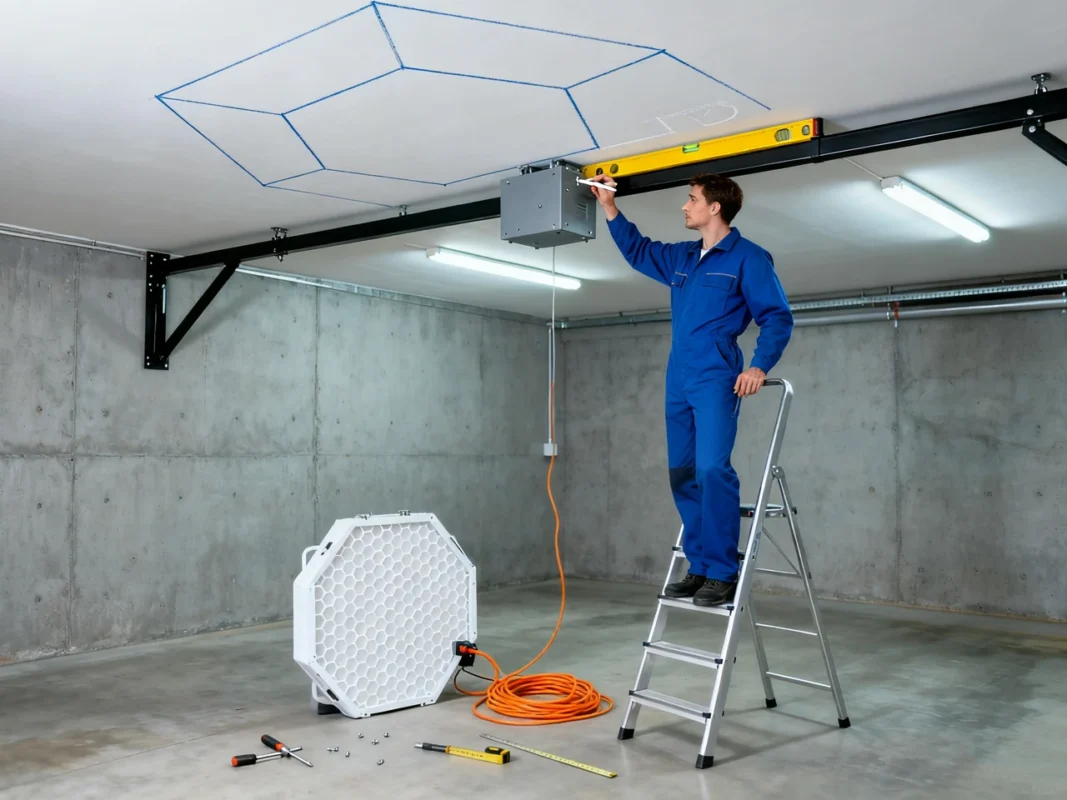
Use painter’s tape or chalk lines on your ceiling to outline where each hexagon module will go. Double-check spacing, symmetry, and alignment before drilling any holes.
Step 2 – Prepare Mounting Points:
Locate ceiling joists or anchor points, and mark them for mounting. If you’re surface-mounting, drill pilot holes and install anchors where needed.
Step 3 – Assemble the Hexagon Grid:
Connect the LED bars into hexagonal modules on the ground first. This makes installation faster and reduces mistakes. For larger grids, assemble sections that you can lift and mount in manageable pieces.
Step 4 – Install Modules to Ceiling:
Secure each hexagon or honeycomb cell to your mounting points. Keep a level handy to ensure the grid is perfectly aligned — crooked lighting can ruin the aesthetic and compromise light distribution.
Step 5 – Connect Wiring and Power:
If using plug-and-play connectors, link the modules and plug them into your power source. If hardwiring, follow proper electrical procedures or consult an electrician.
Step 6 – Test and Adjust:
Once everything is connected, turn on the system and check for dead zones, misalignments, or flickering. Make final adjustments before cleaning up.
Step 7 – Final Safety Checks:
Inspect all connections, secure any loose wires, and ensure fixtures are firmly mounted. If you used suspension cables, verify their tension and stability.
Safety, Code, & Best Practices
Safety should never be an afterthought when installing hexagon shop lights. While most systems are straightforward, ignoring electrical best practices or installation codes can lead to problems down the road.
- Use Proper Circuit Protection: Make sure the breaker and wiring can handle the load. Overloading a circuit with too many LED modules can trip breakers or cause overheating.
- Ground All Fixtures: Proper grounding protects your system and reduces fire risk.
- Seal Against Dust and Moisture: If your garage is prone to humidity or dust, choose fixtures with an IP65 rating or higher to prevent corrosion and electrical shorts.
- Plan for Maintenance: Install fixtures in a way that makes future servicing simple. Easy access to connectors and drivers will save time later.
- Hire a Pro if Needed: If you’re unsure about electrical work, it’s worth hiring a certified electrician. Incorrect wiring can void warranties or create hazards.
Cost & Return on Investment (ROI)
Upgrading to a hexagon lights garage system is more than just a visual or functional upgrade — it’s a strategic investment. While these lighting systems can cost more upfront than conventional fluorescent fixtures or basic LED tubes, the long-term returns they deliver in performance, energy efficiency, productivity, and even property value are significant. Understanding the financial side of hexagon garage lighting will help you decide whether this upgrade is worth it for your space, whether you’re outfitting a small home garage or a full-scale detailing shop.
Upfront Costs vs. Traditional Lighting
The first question most people ask is: “Are hexagon lights worth the cost?” The answer depends on your goals and how you use your space.
- Initial Investment
The cost of hexagon shop lights varies widely depending on the size of your setup, the quality of materials, and whether you’re installing it yourself or hiring a professional. On average:
- Basic DIY kits for a one-car garage: $200 – $400
- Mid-range systems for two-car garages or workshops: $500 – $1,000
- Professional-grade honeycomb lights garage systems for detailing shops or showrooms: $1,500 – $5,000+
This is notably higher than traditional fluorescent or linear LED fixtures, which might range from $100 to $300 for similar coverage. However, the difference in performance and longevity between standard lighting and hexagon lights garage systems is substantial.
- Installation Costs
If you’re comfortable with DIY, many kits are plug-and-play and can be installed with minimal tools, reducing costs significantly. For more complex layouts or hardwired installations, hiring an electrician might cost an additional $200 – $500. While this adds to the initial investment, professional installation ensures safety, optimal performance, and compliance with electrical codes.
- Design and Customization
Custom layouts and larger installations naturally cost more, but they also deliver more dramatic results. A fully integrated hex garage lights ceiling grid not only transforms your space but also creates a premium aesthetic that standard lighting simply can’t replicate.
Energy Savings & Operating Costs
While hexagon garage lighting may require a larger upfront investment, its efficiency and longevity quickly offset that cost. Here’s how:
- Energy Efficiency
High-quality honeycomb lights garage systems use LED technology that produces far more light per watt than traditional lighting. A typical hexagon setup might consume 200–400 watts total while producing over 40,000 lumens. Compare that to multiple fluorescent tubes consuming 600+ watts for similar output, and the savings add up quickly.
For example:
- A standard fluorescent setup might cost $150–$200 per year in electricity.
- A hexagon lights garage system of equivalent brightness could cost $60–$90 per year.
That’s a potential savings of 50% or more annually — and over a 10-year lifespan, the difference becomes substantial.
- Reduced Maintenance Costs
With lifespans of 50,000 hours or more, hex garage lights require far fewer replacements than fluorescent tubes or halogen fixtures. That means fewer purchases, less downtime, and lower labor costs over the long term. Most owners report years of reliable performance without needing to replace a single module.
- Cooler Operation & HVAC Efficiency
LED-based hexagon shop lights produce less heat than traditional lighting. That not only extends the lifespan of the fixtures themselves but can also reduce cooling costs in climate-controlled garages or workshops.
Payback Timeline & Value Add
One of the most compelling aspects of hexagon garage lighting is how quickly it pays for itself. Between energy savings, maintenance reductions, and improved functionality, many users recover their investment in just a few years.
- ROI in Residential Garages
For homeowners, ROI often comes from convenience, visibility, and improved property appeal. A well-lit garage with honeycomb lights garage not only makes daily tasks easier but can also boost resale value. Homebuyers increasingly view modern garages as part of a home’s overall appeal — and unique lighting like hexagon grids sets your property apart.
- ROI in Commercial and Detailing Shops
For professionals, the ROI equation is even stronger. Enhanced visibility leads to better results, fewer errors, and faster turnaround times. Detailers, painters, and mechanics often report higher productivity and customer satisfaction after installing hex garage lights, which can translate directly into revenue growth. A one-time investment of $2,000–$3,000 could pay for itself in under a year if it improves job efficiency and output.
- Intangible Returns: Aesthetics & Brand Perception
The striking appearance of hexagon lights garage systems offers value that’s harder to quantify but equally important. For detailing shops and showrooms, lighting isn’t just about function — it’s part of the brand experience. Clients walking into a brightly lit, futuristic space associate it with professionalism and high standards, making them more likely to trust your services and return for future work.
Long-Term Financial Benefits
When calculating ROI, it’s important to look beyond simple cost savings and consider the long-term benefits that hexagon shop lights bring:
- Higher work quality → fewer costly reworks and happier clients.
- Enhanced property value → a modernized garage or workshop can raise resale prices.
- Lower operating costs → significant reductions in electricity and maintenance expenses.
- Business differentiation → for commercial spaces, a professional lighting setup can become a competitive advantage.
Even if the initial investment feels steep, the combination of tangible and intangible returns makes hexagon lights garage one of the most cost-effective upgrades you can make over the long run.
Final Thoughts on ROI
It’s easy to look at the price tag of a hexagon garage lighting system and hesitate — but when you consider the full picture, the value becomes clear. Lower operating costs, reduced maintenance, improved productivity, and increased property value all contribute to a strong return on investment that far outweighs the initial expense.
For homeowners, honeycomb lights garage setups deliver a functional, visually stunning upgrade that elevates the garage from storage space to true workspace. For professionals, hex garage lights are not just lighting — they’re a tool that improves results, boosts revenue, and strengthens brand image.
In short, if you’re serious about transforming your garage or shop into a brighter, more efficient, and more professional environment, the ROI of hexagon lights garage is difficult to beat.
Real-World Evidence & Use Cases
The true test of any lighting system isn’t just what it promises on paper — it’s how it performs in the real world. Hexagon lights garage systems have quickly moved from being a niche upgrade to a mainstream solution because they consistently deliver results that traditional lighting can’t match. Across residential garages, professional detailing shops, showrooms, and creative studios, real-world examples prove that hexagon garage lighting isn’t just about aesthetics — it’s about transforming how spaces function and feel.
In this section, we’ll explore how hexagon shop lights are used in different environments, why detailers swear by them, and what users are saying after making the switch.
Why Do Detail Shops Use Hexagon Lights?
Walk into any high-end auto detailing shop today, and you’ll almost certainly see hexagon lights garage systems glowing from the ceiling. This isn’t a coincidence — it’s a deliberate choice grounded in performance and precision.
- Unmatched Visibility for Detailing Work
Paint correction and detailing require exceptional lighting to reveal tiny defects that the naked eye might miss under standard illumination. Swirl marks, micro-scratches, dust nibs, and clear coat imperfections become much easier to spot under the even, high-CRI light produced by hexagon garage lighting. This helps detailers work more efficiently and achieve flawless results without constantly repositioning light sources.
- Uniform, Shadow-Free Illumination
Traditional shop lights cast harsh shadows that can obscure small details or distort reflections on a vehicle’s surface. The honeycomb layout of hex garage lights distributes light from multiple angles, minimizing shadows and creating a more accurate view of the surface you’re working on. For tasks like ceramic coating, polishing, or touch-up painting, this uniform light is invaluable.
- Professional Appearance and Customer Confidence
In a service industry where presentation matters, honeycomb lights garage systems create an immediate impression of professionalism and quality. Clients walking into a well-lit, futuristic detailing bay are more likely to trust the business with their high-value vehicles. The lighting itself becomes part of the customer experience and brand identity.
- Better Workflow and Productivity
Detailers report that hexagon shop lights reduce the time spent repositioning mobile lights or checking work under multiple lighting conditions. The consistent illumination means they can focus on the job at hand, boosting both speed and accuracy — which ultimately translates into more cars serviced and higher revenue.
Case Studies & Testimonials
Case Study 1: Home Garage Transformation
Jason, a car enthusiast from Texas, installed a mid-range hexagon lights garage kit in his two-car garage. Before the upgrade, the space relied on a few dim fluorescent fixtures, leaving dark corners and frustrating visibility issues. After installation, Jason reported a 300% increase in brightness and near-total elimination of shadows. “It’s like working in daylight at any time of day,” he says. “I can finally see what I’m doing when polishing or working under the hood — and it looks incredible, too.”
Case Study 2: Professional Auto Detailing Shop Upgrade
A detailing studio in California replaced its standard tube lights with a custom honeycomb lights garage grid. The result? A significant improvement in inspection accuracy and faster turnaround times. The owner notes, “We catch defects now that we never noticed before. Customers have commented on the lighting — it makes the shop feel high-end, and that helps justify our premium pricing.”
Case Study 3: Showroom Aesthetics Meets Functionality
A luxury car dealership in the UK integrated hex garage lights into its main display area. The system not only improved color rendering and made the vehicles pop visually but also became a focal design feature of the showroom. “Buyers consistently mention the lighting — it creates an atmosphere that matches the quality of the cars,” says the dealership’s design manager.
Case Study 4: Creative Studio Adoption
Photographers and content creators have also embraced hexagon garage lighting for their studios. The shadow-free, daylight-like illumination makes it easier to capture accurate product shots and vehicle photography. Combined with the futuristic look of the honeycomb design, it creates a visually appealing backdrop for social media and promotional content.
Feedback, Issues, and Lessons Learned
While the real-world performance of hexagon lights garage is overwhelmingly positive, users also share valuable lessons that can help new adopters get the best results:
- Plan Your Layout First: Rushing into installation without careful planning often leads to uneven coverage or wasted modules. Mapping the design on paper or digitally first prevents costly mistakes.
- Balance Aesthetics and Function: While a full honeycomb grid looks impressive, it may not always be necessary. Many users recommend focusing lighting where it’s needed most — over workbenches, vehicles, or tool areas — and adding more later if required.
- Don’t Skimp on Quality: Cheaper, low-CRI LED kits can compromise the benefits of hexagon shop lights. Investing in a reputable brand ensures consistent color accuracy and longer lifespan.
- Hire an Electrician if Unsure: DIY is possible for many installations, but incorrect wiring can lead to flickering, premature failure, or even safety hazards. Professionals ensure code compliance and optimal performance.
Even with these caveats, satisfaction rates among users remain extremely high. Most say they would never go back to traditional lighting after switching to hexagon garage lighting — and many end up expanding their systems over time.
Performance Optimization & Maintenance Tips
Positioning & Angle Best Practices
- Tilt modules slightly inward or toward work areas to mitigate glare.
- Avoid direct eye-level exposure—use offsets or shielding.
- Overlap coverage to eliminate dead zones.
- Use more dense grid over workbench or car zones; sparser grid in storage zones.
- Fine-tune aiming after initial lighting test.
Cleaning, Inspection & Lifespan
- Clean diffusers with a soft damp cloth occasionally (dust buildup reduces output).
- Check module connectors periodically; loose connections degrade performance.
- Monitor for brightness drop over time; ideally modules degrade slowly.
- Replace or swap modules before they fail entirely to maintain grid consistency.
Upgrades, Add-ons & Expansion
- Add modules later (many systems support expansion).
- Integrate dimming controls, smart switches, motion sensors.
- Blend hex grid with accent lights or strip lights for layered lighting.
- Use modular re-layout if your garage usage changes.
Comparison with Alternative Garage Lighting
Versus Linear LED / Shop Tube Lights
- Linear LED tubes often produce strong shadows and uneven coverage.
- Hexagon garage lighting excels in uniform spread, thanks to multiple angular sources.
- In terms of cost per lumen, linear tubes may be cheaper—but they often lack the coverage finesse.
Versus High Bay LED Fixtures
- High bay fixtures make sense in tall, open spaces.
- In a typical garage with moderate ceiling height, high bays may overdo intensity or leave side zones dim.
- Hex grids provide more controlled, distributed light at closer heights.
Hybrid or Mixed Lighting Approaches
- Some garage owners mix hex grids with task strip lights (above benches, tool walls).
- Use ambient hex grid plus accent directional lights for shadow fill.
- A layered lighting design often delivers both function and visual appeal.
Conclusion
Alright, you’ve now got the full picture: what hexagon lights garage systems are, how they work, the benefits and drawbacks, how to install them properly, costs and ROI, plus real-world evidence and FAQs. If you’re building a high-performance garage or detail bay, hex grids are no longer futuristic—they’re effective and trusted.
If I were you, here’s what I’d do next:
- Sketch your garage layout and decide your lumen target.
- Choose a modular grid that fits comfortably—and leave room for expansion.
- Order a quality kit (check CRI, cooling, warranty).
- Lay it out on the floor before mounting.
- Follow step-by-step wiring and safety rules.
- Test and tweak alignment.
Frequently Asked Questions
Are hexagon lights good for a garage?
Absolutely — hexagon lights garage systems are one of the best lighting upgrades you can make. Their modular honeycomb design delivers uniform, shadow-free illumination that traditional fluorescent or single-point lights simply can’t match. This makes them ideal for everything from car maintenance and detailing to woodworking and home projects.
They’re also energy-efficient, long-lasting, and visually striking. Beyond function, they give your garage a modern, professional look that adds value and transforms how you use the space.Are hexagon lights worth the cost?
Yes, in most cases they are well worth the investment. While the upfront cost of hexagon garage lighting may be higher than standard fixtures, the long-term benefits far outweigh it. You’ll save money on energy bills thanks to LED efficiency, reduce maintenance costs with their long lifespan, and enjoy vastly improved visibility.
For detailing shops, showrooms, or commercial garages, the ROI can be even greater — better lighting leads to improved results, happier clients, and potentially higher revenue. Even homeowners see a return in property value and usability.Can hexagon lights improve garage visibility?
Without question. Hexagon shop lights are specifically designed to eliminate dark spots and shadows, flooding the space with bright, even light. Their high lumen output, wide beam angles, and excellent color rendering index (CRI) make them especially effective for detailed work like polishing, painting, or mechanical repairs.
Users often describe the effect as “daylight indoors” — you’ll see surface defects, tools, and fine details much more clearly than under standard lighting.Do hexagon lights require special wiring?
In most cases, no — many hex garage lights are plug-and-play and can connect directly to standard 110–120V outlets (or 220–240V in some regions). That said, the specifics depend on the model and installation type.
• DIY kits are typically easy to install with basic tools.
• Hardwired systems may require professional installation to integrate with existing circuits or smart controls.
If you’re planning a large or permanent installation, hiring a licensed electrician ensures safety, compliance, and optimal performance.Why do detail shops use hexagon lights?
Detailers rely on honeycomb lights garage systems because they provide the precision lighting needed to deliver flawless results. The bright, even illumination highlights swirl marks, scratches, and paint imperfections that standard lights might miss.
Additionally, the futuristic honeycomb design creates a professional, high-end appearance that clients notice immediately. It builds trust and reinforces the perception of quality — which is critical in a competitive detailing industry.How long do hexagon garage lights last?
Most high-quality hexagon lights garage systems are rated for 50,000 hours or more, which translates to well over a decade of use for typical residential or commercial applications. This long lifespan reduces maintenance costs and minimizes the need for replacements, even in high-use environments like workshops or detailing bays.
Can I install hexagon shop lights myself?
Yes — many hexagon shop lights are designed with DIY users in mind. They often come with modular connectors and mounting hardware that make installation straightforward, even for beginners. However, if your setup involves complex wiring, integration with existing lighting systems, or smart home features, it’s best to hire a professional electrician.
Are hexagon lights customizable in shape and size?
Definitely. One of the biggest advantages of hex garage lights is their modularity. You can configure them into various shapes — from simple hexagonal grids to complex honeycomb patterns — to match your space and lighting needs. This flexibility allows you to focus illumination over work areas, vehicles, or specific zones while maintaining a cohesive and modern look.
Do hexagon lights work in cold or damp garages?
Yes. Quality hexagon garage lighting systems are built to withstand a range of environmental conditions, including cold temperatures and moderate humidity. Look for models with IP-rated housings (e.g., IP65) if your garage is unheated or exposed to moisture, as these will offer better protection against dust and water ingress.
Can I use hexagon lights outside of a garage?
Absolutely — while hexagon lights garage systems are most popular in garages and workshops, they’re also great for showrooms, studios, retail spaces, gyms, and creative environments. Their combination of high-performance lighting and eye-catching design makes them versatile enough for many indoor applications beyond automotive use.
What color temperature is best for a garage setup?
Most professionals recommend a color temperature between 5000K and 6500K, which closely mimics natural daylight. This range provides bright, crisp light that enhances visibility and makes colors appear more accurate — an essential feature when inspecting paint, detailing vehicles, or doing precision work.
Are hexagon lights energy-efficient?
Yes — honeycomb lights garage systems use LED technology, which is significantly more energy-efficient than traditional fluorescent or halogen bulbs. They deliver higher brightness per watt, produce less heat, and can lower your energy bills by 40–60%. Over time, those savings contribute to the strong ROI these systems are known for.