

Table of Contents
If you’re researching solar street lights outdoor, you’re probably trying to solve a real-world problem — not just browse specs.
Maybe you’re lighting a rural road where trenching power lines would cost a fortune.
Maybe you’re upgrading a commercial property and want to slash electricity bills.
Or maybe you’re simply tired of unreliable grid lighting in parking areas.
Solar street lights outdoor can be a fantastic solution — but only if you size, mount, and maintain them correctly.
What Solar Street Lights Outdoor Actually Solve (And When They Don’t)
Let’s get real.
The biggest mistake people make with solar street lights outdoor is assuming they’re plug-and-play magic.
They’re not.
They solve very specific problems extremely well:
When Solar Street Lights Outdoor Make Perfect Sense
- Remote roads with no utility access
- Rural farms and ranch entrances
- Construction sites
- Parking lots
- HOA community paths
- Municipal parks
- Commercial properties looking to cut energy costs
If trenching power lines costs $15–$25 per foot (which is common), installing solar street lights outdoor often becomes cheaper immediately.
When They Might Not Be Ideal
- Dense urban cores with heavy shading
- Extremely narrow alleys requiring directional optics
- Sites with constant vandalism risk without protective mounting
The truth? Modern commercial solar street lamps are far more capable than older versions. But you still have to match the fixture to the site.
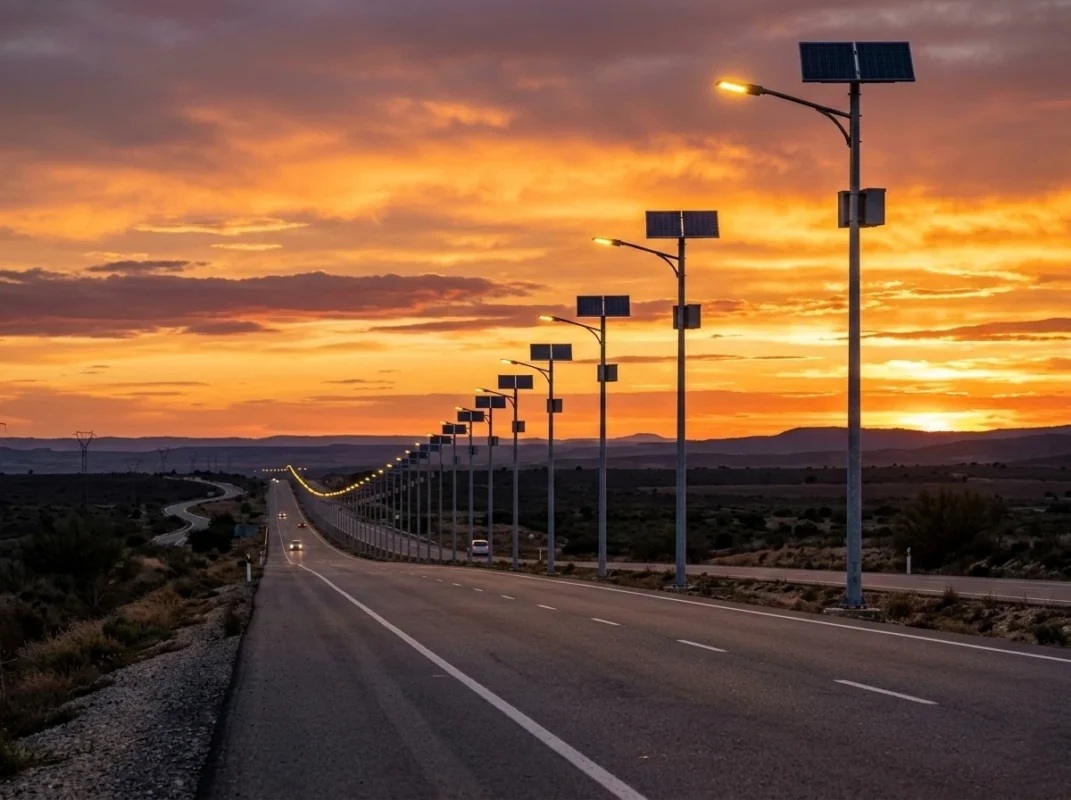
Types of Solar Street Lights Outdoor (Know What You’re Buying)
Not all solar street lights outdoor are built the same — and if you pick the wrong type, even the best-looking fixture can underperform in real-world conditions.
I’ve reviewed dozens of failed installations over the years. In almost every case, the issue wasn’t “solar doesn’t work.” It was a mismatch between the type of system and the actual site conditions.
Before you compare prices, you need to understand how different categories of solar street lights outdoor are engineered — and where each one truly fits.
Let’s break them down the way contractors and lighting planners do in the field.
All-In-One (Integrated) Solar Street Lights Outdoor
All-in-one systems combine:
- LED luminaire
- Solar panel
- Battery
- Controller
into a single housing mounted at the top of the pole.
These are often the most popular solar street lights outdoor for small projects because installation is straightforward. Fewer components mean fewer wiring steps.
Best suited for:
- Residential streets
- Small parking areas
- HOA pathways
- Farm driveways
- Temporary construction lighting
Advantages:
- Quick installation
- Lower upfront labor cost
- Clean appearance
- Minimal external wiring
Limitations:
- Limited panel size (affects charging capacity)
- Heat buildup in high-temperature climates
- Battery replacement can be more complicated
From experience, integrated solar street lights outdoor work well when the pole height stays under 20 feet and lighting demand is moderate. If you’re pushing higher lumen output or longer autonomy days, you may outgrow this design quickly.
Split Type Solar Street Light (For Higher Output & Flexibility)
A split type solar street light separates the components:
- Solar panel mounted independently
- Battery housed inside pole or weatherproof enclosure
- LED luminaire installed separately
This design gives you flexibility — and flexibility is power in commercial applications.
When clients ask for higher performance, I almost always steer them toward split configuration solar street lights outdoor.
Why?
Because you can:
- Increase panel size without changing fixture aesthetics
- Install larger battery banks
- Improve airflow for battery longevity
- Service components individually
Best suited for:
- Industrial yards
- Municipal roads
- Large parking facilities
- High-lumen applications
- Projects needing multi-day battery backup
Split systems are also ideal when installing a 1000W solar street light equivalent output (remember, lumen output matters more than wattage labels). Larger systems simply require larger panels and storage capacity — something integrated units physically can’t accommodate as easily.
For long-term municipal infrastructure, split type solar street lights outdoor typically provide better lifecycle value.
Commercial Solar Street Lamps (Heavy-Duty Systems)
When we talk about commercial solar street lamps, we’re stepping into a different category of performance.
These are engineered for:
- Long operating hours
- High wind resistance
- Strict safety compliance
- Photometric planning
Commercial-grade solar street lights outdoor should include:
- Corrosion-resistant housing
- Advanced charge controllers
- Programmable dimming profiles
- Battery management systems
- Certified waterproof IP65 solar light rating (minimum)
In real commercial projects — shopping centers, logistics facilities, business parks — reliability is everything. If a light goes out in a parking lot, it becomes a liability issue.
That’s why professional solar street lights outdoor used commercially are designed with redundancy and performance margins built in.
Solar Parking Lot Lights (Wide Distribution Optics)
Solar parking lot lights are not the same as roadway lights.
Parking lots require:
- Wider beam angles
- Uniform distribution
- Reduced glare
- Even pole spacing
Using narrow roadway optics in a parking area creates hot spots directly under poles and dark zones between them — a mistake I’ve seen more than once.
Well-designed solar street lights outdoor for parking applications include photometric layout simulations to ensure consistent illumination across the lot.
For retail properties and apartment complexes, proper optical distribution matters more than chasing the “brightest solar outdoor light” marketing claim.
Uniformity beats raw brightness every time.
Dusk to Dawn Solar Pole Light Systems (Automatic Operation)
Most modern solar street lights outdoor operate as a dusk to dawn solar pole light, meaning:
- Automatically turn on at sunset
- Automatically turn off at sunrise
This is handled by a built-in light sensor within the controller.
Higher-end systems allow:
- Midnight dimming schedules
- Motion sensor boost modes
- Adjustable lighting profiles
For example, a light may run at 100% output for 5 hours, then reduce to 50% after midnight to conserve battery while still maintaining security visibility.
Dusk-to-dawn functionality is critical for:
- Public roadways
- Security perimeters
- School campuses
- Industrial sites
If a system doesn’t clearly state dusk-to-dawn control capability, it’s not a serious solar street lights outdoor solution.
High-Lumen Systems (Including 1000W Solar Street Light Class)
The term 1000W solar street light is often used in marketing, but what professionals care about is actual lumen output and battery capacity.
High-lumen solar street lights outdoor typically feature:
- Larger solar arrays
- High-capacity lithium batteries
- Heat-dissipating aluminum housings
- Elevated mounting heights (20–30 feet)
These systems are used for:
- Major roadways
- Large parking complexes
- Transportation hubs
- Industrial facilities
When evaluating high-output models, always confirm:
- Actual lumen rating
- Battery amp-hour capacity
- Autonomy days
- Solar panel wattage
Without those specs, “1000W” is just a sticker.
Waterproof IP65 Solar Light Designs (Environmental Protection)
Weather protection isn’t optional.
A waterproof IP65 solar light rating means:
- Protected against dust ingress
- Resistant to water jets from any direction
For most outdoor environments, IP65 is the minimum acceptable rating for solar street lights outdoor.
In coastal or high-humidity areas, I recommend checking:
- Anti-corrosion coating
- Stainless steel fasteners
- UV-resistant wiring
Poor sealing leads to moisture intrusion, which leads to controller failure — and that’s one of the most common field repair issues I see.
The Brightest Solar Outdoor Light — What That Really Means
Everyone wants the brightest solar outdoor light.
But brightness without planning creates glare, wasted energy, and unhappy neighbors.
Professional lighting design considers:
- Lumens per square foot
- Pole height
- Beam angle
- Spacing ratio
The “brightest” solar street lights outdoor are the ones that deliver usable illumination where it’s needed — not just maximum output at the LED chip.
In practical terms, well-distributed 15,000 lumens can outperform poorly distributed 25,000 lumens.
That’s something you only learn from field installations.
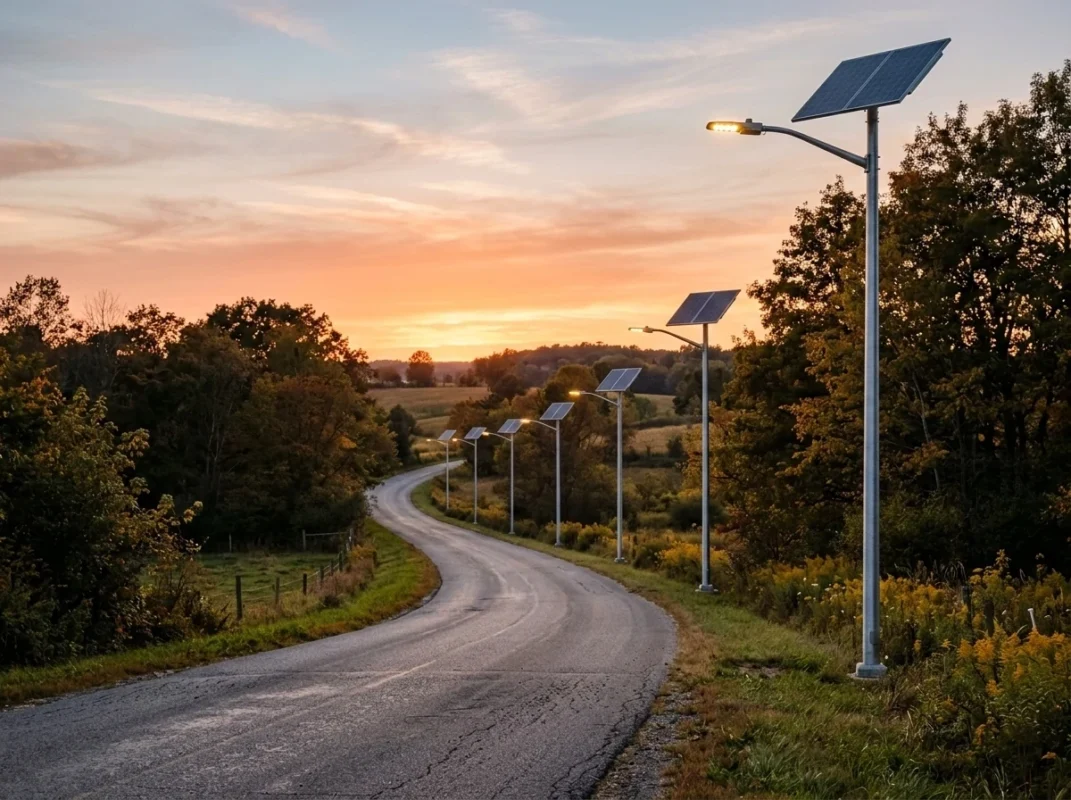
How Bright Should Solar Street Lights Outdoor Be?
One of the most misunderstood questions.
People ask for wattage — like “I need a 1000W solar street light.”
Wattage is meaningless without context.
Lumens Matter More Than Watts
When evaluating solar street lights outdoor, focus on:
- Lumens
- Beam angle
- Mounting height
- Pole spacing
For example:
| Application | Recommended Lumens |
|---|---|
| Residential road | 4,000–8,000 |
| Parking lot | 10,000–20,000 |
| Highway-grade lighting | 20,000+ |
The brightest solar outdoor light isn’t about wattage marketing. It’s about usable illumination on the ground.
How Many Lumens Is a Solar Street Light?
This depends on application, but most solar street lights outdoor range from 3,000 lumens to over 25,000 lumens.
If someone advertises a “1000W solar street light,” verify actual lumen output — that’s what matters.
Understanding Commercial Solar Street Lamps for Larger Projects
For commercial use, solar street lights outdoor need to meet higher standards.
Key Requirements for Commercial Solar Street Lamps
- High-efficiency monocrystalline panels
- LiFePO4 battery chemistry
- Waterproof IP65 solar light rating minimum
- Wind load resistance
- Programmable controller
A true waterproof IP65 solar light ensures rain and dust protection — but in hurricane zones, I recommend checking wind certification too.
Solar Parking Lot Lights vs Roadway Lights
Solar parking lot lights require wider beam distribution. Roadway lights need forward-throw optics.
If you use roadway optics in a parking lot, you’ll get uneven coverage.
Do Solar Street Lights Outdoor Stay On All Night?
This is probably the most common question I hear when someone is considering solar street lights outdoor:
“Will they actually stay on all night — or shut off at 2 a.m.?”
It’s a fair concern. Nobody wants a dark parking lot or road halfway through the night.
The short answer? Yes — properly designed solar street lights outdoor are engineered to run from dusk to dawn.
But the long answer depends on sizing, battery capacity, and how the system is programmed. Let’s break this down the way we would on a real project.
How Dusk-to-Dawn Operation Actually Works
Most modern solar street lights outdoor function as a dusk to dawn solar pole light system. That means they include:
- A built-in light sensor (photocell)
- An intelligent charge controller
- A programmable battery management system
When ambient light drops below a certain lux level at sunset, the controller automatically activates the LED fixture. At sunrise, it shuts the light off and begins charging again.
There’s no timer guessing. No manual switching.
For commercial installations, especially commercial solar street lamps, the controller is often programmable. That allows for:
- Full brightness for the first 4–6 hours
- Reduced output after midnight
- Motion-sensor boost modes
- Adjustable runtime profiles
This programming is one of the reasons modern solar street lights outdoor are far more reliable than older models from a decade ago.
What Determines Whether Solar Street Lights Outdoor Last All Night?
If a system is cutting off early, something in the design wasn’t calculated correctly.
Here are the four factors that truly determine overnight performance:
- Solar Panel Size
The panel must generate enough energy during daylight hours to fully recharge the battery.
If you install solar street lights outdoor in a cloudy region and use undersized panels, nighttime runtime will suffer — especially in winter.
- Battery Capacity
Battery storage is the backbone of reliable operation.
Professional-grade solar street lights outdoor are typically designed with:
- 10–14 hours nightly runtime
- 2–5 days of autonomy (backup capacity for cloudy weather)
Lower-end systems may only support 1 night of autonomy. After two cloudy days, they dim early or shut off completely.
In my experience, undersized batteries are the number one cause of failure in poorly performing solar street lights outdoor.
- Geographic Location & Solar Irradiance
Sunlight availability varies significantly by region.
For example:
- Southern states receive stronger average daily sun exposure.
- Northern regions require larger panels and battery banks to achieve true dusk-to-dawn operation.
A properly engineered solar street lights outdoor system factors in historical solar irradiance data for the installation site. That’s standard practice for serious commercial projects.
- Lighting Profile & Dimming Strategy
Not every system runs at 100% brightness all night — and that’s intentional.
Many solar street lights outdoor use staged dimming:
- 100% output early evening
- 70% after peak traffic hours
- 50% overnight
This extends battery life while maintaining safety.
For applications like solar parking lot lights, dimming strategies can significantly increase reliability during extended cloudy periods.
Do Solar Street Lights Stay On All Night in Winter?
Yes — but winter is where system sizing really shows.
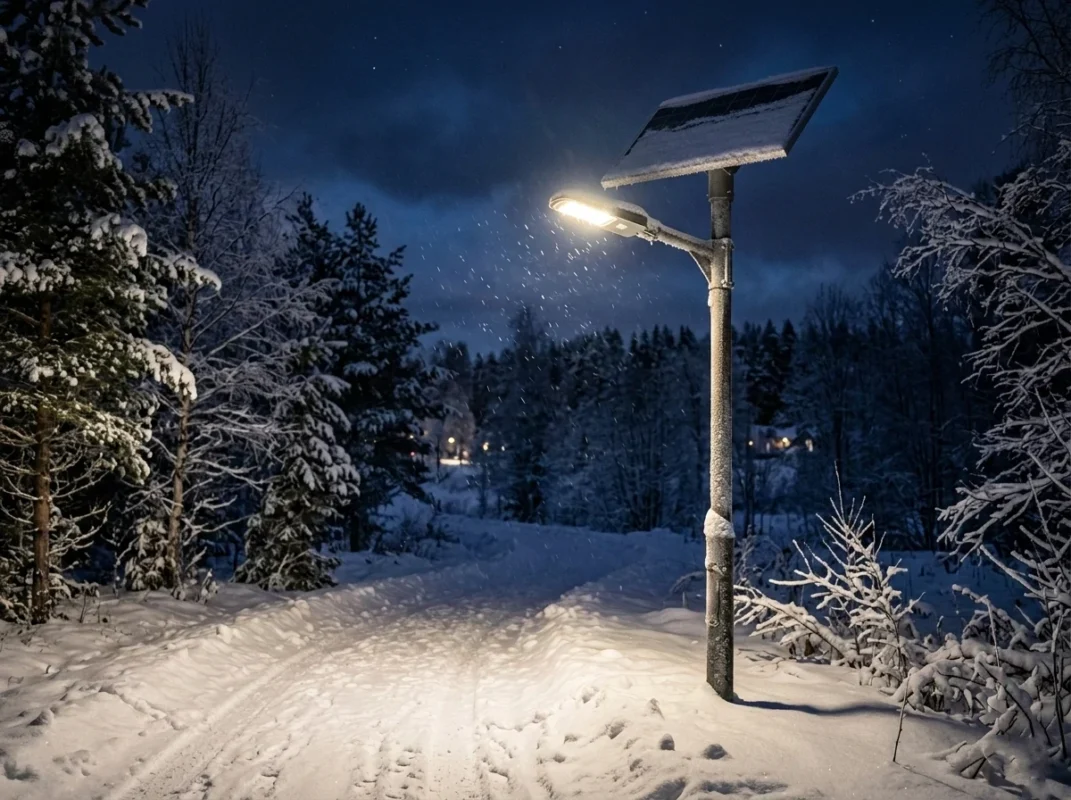
Shorter daylight hours and lower sun angles reduce charging efficiency. Snow buildup can also block panels if not cleared.
Well-designed solar street lights outdoor compensate for winter by:
- Using higher-efficiency solar panels
- Increasing battery capacity
- Programming smarter dimming cycles
Lithium-based batteries perform better in cold weather compared to older battery types, maintaining more stable voltage through the night.
If a system was designed for summer conditions only, winter is when you’ll notice early shut-offs.
What Causes Solar Street Lights Outdoor to Turn Off Early?
If lights aren’t staying on all night, here are the usual suspects:
- Shading from nearby buildings or trees
- Dirty solar panels reducing charging efficiency
- Battery degradation over time
- Incorrect installation angle
- Low-quality charge controller
I’ve inspected sites where a tree planted years after installation slowly reduced panel exposure. Over time, runtime dropped from 12 hours to 7 hours.
The technology wasn’t the problem. Site changes were.
Regular maintenance ensures solar street lights outdoor continue operating at full dusk-to-dawn capacity.
How Commercial Solar Street Lamps Ensure Reliable All-Night Operation
In commercial applications, downtime isn’t acceptable.
That’s why professional commercial solar street lamps often include:
- Oversized solar arrays
- Advanced battery management systems
- Temperature compensation controls
- Real-time performance monitoring
For high-demand sites like logistics yards using solar parking lot lights, engineers typically design for at least 3 days of autonomy. That means even after several cloudy days, the lights still run through the night.
This margin is what separates infrastructure-grade solar street lights outdoor from decorative residential units.
Can You Adjust Runtime on Solar Street Lights Outdoor?
Yes — in most modern systems.
Programmable controllers allow you to:
- Set custom lighting hours
- Choose dimming percentages
- Activate motion-based brightness boosts
- Extend battery backup during low-charge periods
If runtime flexibility matters to you, verify that the solar street lights outdoor model supports programmable profiles.
Some budget units only offer fixed output, which reduces adaptability in changing weather conditions.
Battery Life — The Hidden Factor
If you remember nothing else about solar street lights outdoor, remember this:
The battery is everything.
How Long Do Solar Street Light Batteries Last?
Typical lifespan:
- Lead-acid: 2–4 years
- Lithium (LiFePO4): 5–10 years
Most modern solar street lights outdoor now use lithium iron phosphate batteries due to:
- Thermal stability
- Longer cycle life
- Better cold-weather performance
Can You Replace Batteries in Solar Street Lights?
Yes — in most professional systems.
However, many low-cost integrated solar street lights outdoor make battery replacement difficult.
This is why split type solar street light systems are preferred for long-term municipal projects.
Do Solar Street Lights Outdoor Work in Winter?
Short answer: Yes — but performance depends on location.
Do Solar Street Lights Work in Winter?
They work as long as:
- Panels receive direct sunlight
- Snow is cleared
- Battery is rated for low temperatures
Lithium batteries perform better in cold climates than traditional lead-acid.
In northern states, I always recommend oversizing panel capacity by 15–25% for winter reliability.
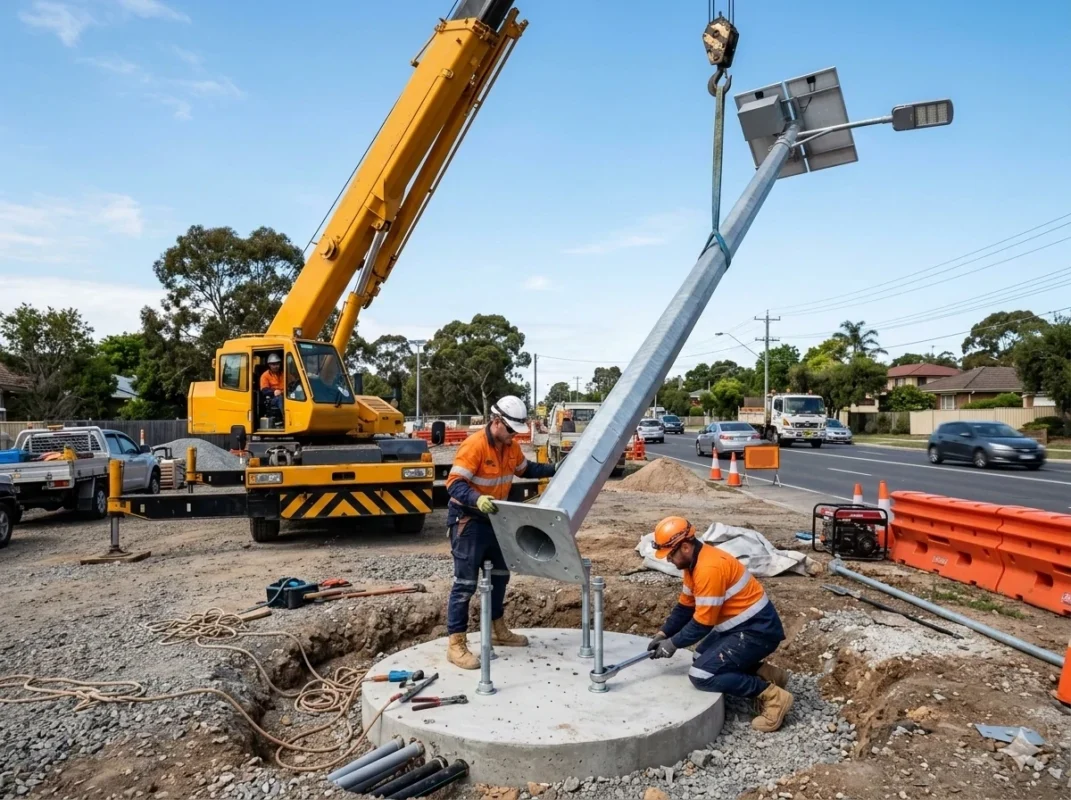
Mounting Height & Pole Design
If I had to name one factor that quietly determines whether solar street lights outdoor perform beautifully or disappoint everyone on site, it’s this:
Mounting height and pole design.
You can buy the brightest solar outdoor light on paper. You can choose high-capacity batteries and a properly rated waterproof IP65 solar light fixture. But if the pole height is wrong — or the pole isn’t structurally matched to the load — the entire system suffers.
This is where real-world experience matters. Lighting isn’t just about lumens. It’s geometry, physics, wind load, and distribution.
Let’s break this down properly.
Why Mounting Height Matters More Than Most People Think
When installing solar street lights outdoor, mounting height directly affects:
- Light distribution pattern
- Ground illumination uniformity
- Glare control
- Pole spacing requirements
- Perceived brightness
Here’s what happens in the field:
- Mount too low → harsh glare, tight bright circle, dark edges.
- Mount too high → wide coverage but weak ground lux levels.
Lighting design is a balance between height and lumen output.
For example, a system delivering 12,000 lumens behaves very differently at 15 feet versus 25 feet.
This is why professional layouts for commercial solar street lamps always calculate pole height before fixture selection — not after.
Recommended Mounting Heights by Application
Based on standard roadway and parking lot practices, here’s a practical guideline for solar street lights outdoor:
| Application | Typical Mounting Height |
|---|---|
| Walkways & pathways | 10–15 ft |
| Residential streets | 15–20 ft |
| Small parking areas | 18–22 ft |
| Large parking lots | 20–30 ft |
| Industrial roads | 25–35 ft |
For solar parking lot lights, 20–30 feet is common because higher mounting improves coverage and reduces pole count.
For a dusk to dawn solar pole light in a residential driveway, 12–15 feet is usually ideal.
Height must match lumen output. A high-lumen system such as a 1000W solar street light equivalent needs higher mounting to distribute light evenly.
The Relationship Between Height and Brightness
Here’s a concept many buyers overlook:
When you double mounting height, light intensity at ground level drops significantly unless lumen output increases accordingly.
That’s basic photometric behavior.
So if someone installs solar street lights outdoor at 25 feet but uses a fixture designed for 15 feet, the result is dim ground coverage — even if the spec sheet claims high wattage.
This is also why chasing “the brightest solar outdoor light” without matching pole height leads to disappointing results.
Brightness isn’t just about output — it’s about correct positioning.
Pole Spacing: Height Affects Layout
Mounting height also determines pole spacing.
Higher poles allow wider spacing between solar street lights outdoor, which can reduce total pole count in large projects.
For example:
- 15 ft mounting → 60–80 ft spacing
- 25 ft mounting → 100–130 ft spacing
This matters for:
- Large commercial properties
- Industrial yards
- Solar parking lot lights installations
Improper spacing creates alternating bright and dark zones — a common mistake in DIY layouts.
Professionally designed commercial solar street lamps use photometric modeling to determine ideal spacing ratios.
Structural Considerations for Pole Design
The pole is not just a support structure — it’s part of the engineered system.
Solar adds additional wind load because the panel acts like a sail.
When evaluating solar street lights outdoor, always check:
- Pole material (steel or aluminum)
- Wall thickness
- Wind load rating
- Anchor bolt size
- Base plate dimensions
In hurricane-prone regions, poles must be rated for high wind speeds. I’ve seen improperly rated poles bend after severe storms — not because of poor light quality, but because the structure wasn’t designed for solar panel drag.
For commercial solar street lamps, wind certification and foundation calculations are essential.
Foundation Depth & Stability
Pole stability starts underground.
Typical foundation guidelines for solar street lights outdoor:
- 4–6 feet embedment for direct-bury poles
- Concrete foundation sized according to pole height and soil conditions
- Anchor bolt templates aligned precisely
Taller poles supporting high-output systems like a split type solar street light or 1000W solar street light equivalent require larger foundations.
Soil type also matters. Sandy soil requires deeper or wider footings compared to compact clay.
Skipping proper foundation sizing is one of the most expensive mistakes in outdoor lighting projects.
Panel Orientation & Tilt Angle
Mounting height is only part of the equation. Panel angle determines charging efficiency.
For solar street lights outdoor, panels should:
- Face true south in the U.S.
- Be tilted according to geographic latitude
- Avoid shading from nearby trees or buildings
Improper tilt reduces winter charging performance significantly.
For split type solar street light systems, panel angle is often adjustable, which improves seasonal performance compared to fixed integrated designs.
Glare Control & Safety
Mounting height directly affects glare.
If solar street lights outdoor are mounted too low in parking areas, drivers experience eye-level glare — especially with high-output LED arrays.
Higher mounting:
- Improves visual comfort
- Reduces harsh brightness perception
- Enhances uniformity
For solar parking lot lights, glare control is a safety issue — not just an aesthetic concern.
Good lighting should illuminate the ground, not blind the user.
Aesthetic Considerations in Residential Installations
In residential areas, pole height affects visual impact.
Homeowners associations often limit:
- Maximum pole height
- Fixture size
- Appearance
In these settings, integrated solar street lights outdoor mounted between 12–18 feet typically provide a good balance between function and visual harmony.
Dusk to dawn solar pole light systems are popular in these environments because they operate automatically without visible wiring.
Matching High-Lumen Systems to Pole Height
When installing higher-output systems such as commercial solar street lamps or high-lumen split type solar street light models, pole height must increase accordingly.
A common pairing:
- 15,000 lumens → 18–22 ft
- 20,000 lumens → 22–28 ft
- 25,000+ lumens → 25–35 ft
Installing a powerful system at 15 feet can create excessive glare and uneven distribution.
Mounting it too high without sufficient lumens leads to under-lighting.
Balance is everything.
Practical Field Advice Before You Install
Before installing solar street lights outdoor, ask yourself:
- What is the target ground illumination level?
- How wide is the area to be covered?
- What is the optimal pole spacing?
- What wind speeds must the pole withstand?
- Is the foundation engineered for soil conditions?
If you can’t answer those questions, pause before pouring concrete.
Lighting failures rarely come from LED quality. They come from poor planning.
Installation: Should You DIY?
Here’s the honest answer.
When DIY Is Realistic
- Single light
- Small driveway
- Basic dusk to dawn solar pole light
- Pre-assembled pole
When You Should Hire a Professional
- 20+ foot poles
- Concrete foundation work
- Multiple solar parking lot lights
- Commercial code compliance
Installing solar street lights outdoor isn’t complicated — but it involves structural safety.
Maintenance — The Overlooked Reality
Solar lighting is low maintenance. Not no maintenance.
How Do You Maintain Solar Street Lights?
- Clean solar panels every 6–12 months
- Inspect wiring annually
- Check mounting bolts
- Replace batteries at end-of-life
- Ensure IP65 seals remain intact
A properly installed waterproof IP65 solar light should resist rain, dust, and debris — but periodic inspection prevents surprises.
Are Solar Street Lights Outdoor Worth the Money?
Are Solar Street Lights Worth the Money?
In most cases — yes.
Consider:
- Zero trenching cost
- No electric bill
- Minimal maintenance
- Long lifespan
For remote areas, solar street lights outdoor often cost less over 5–10 years than grid-connected lighting.
The ROI is strongest for:
- Rural roads
- Farms
- Commercial lots
- Temporary construction sites
Common Mistakes That Kill Solar Street Lights Outdoor Performance
- Undersizing battery
- Ignoring shading analysis
- Mounting too low
- Buying based on wattage marketing
- Not planning pole spacing
The difference between frustration and reliability usually comes down to design calculations.
Final Thoughts: Choosing Solar Street Lights Outdoor the Smart Way
If you’ve read this far, you already know:
Solar street lights outdoor are not gadgets. They’re infrastructure.
When designed properly, they:
- Deliver consistent lighting
- Cut energy costs
- Avoid trenching
- Reduce maintenance headaches
But they require thoughtful sizing, proper mounting, and realistic expectations.
If you’re installing one light for a driveway, you might DIY it.
If you’re planning a full lot with multiple solar parking lot lights or large-scale commercial solar street lamps, treat it like the engineering project it is.
Done right, solar street lights outdoor can last a decade or more — lighting roads, lots, and communities without ever touching the grid.
Frequently Asked Questions
How many lumens is a solar street light?
Most solar street lights outdoor range from 3,000 to 25,000+ lumens depending on the application.
• 3,000–8,000 lumens: pathways and small roads
• 10,000–20,000 lumens: parking lots
• 20,000+ lumens: large commercial or industrial areas
Always focus on lumen output and mounting height — not advertised wattage.
Do solar street lights stay on all night?
Yes, properly sized solar street lights outdoor are designed to operate from dusk to dawn, typically 10–14 hours.
Reliable systems include sufficient battery capacity and 2–5 days of backup autonomy to handle cloudy weather.
If lights turn off early, the issue is usually undersized panels, degraded batteries, or shading — not the solar technology itself.
How long do solar street light batteries last?
Battery lifespan depends on chemistry and usage.
• Lead-acid: 2–4 years
• Lithium (LiFePO4): 5–10 years
Most modern commercial solar street lamps use lithium batteries for longer cycle life and better temperature stability.
Regular maintenance helps maximize battery performance in solar street lights outdoor systems.
Are solar street lights worth the money?
In many cases, yes.
When trenching and electrical infrastructure costs are high, solar street lights outdoor often provide strong long-term ROI. You eliminate electricity bills, reduce wiring costs, and minimize ongoing maintenance.
They are especially cost-effective for rural roads, parking lots, farms, and remote commercial sites.
How high should a solar street light be mounted?
Typical mounting heights for solar street lights outdoor:
• 10–15 ft for walkways
• 15–20 ft for residential streets
• 20–30 ft for parking lots
Pole height must match lumen output and spacing to ensure uniform illumination and minimal glare.
Do solar street lights work in winter?
Yes, but system sizing matters.
Quality solar street lights outdoor are designed for winter conditions with adequate panel capacity and battery storage. In colder climates, lithium batteries generally perform better and maintain stable output through long nights.
Clearing snow from panels improves charging efficiency.
Can you replace batteries in solar street lights?
In most professional systems, yes.
Split type solar street light designs typically allow easier battery replacement. Some fully integrated units may be more difficult to service, so check accessibility before purchasing.
Battery replacement is a normal part of long-term maintenance for solar street lights outdoor.
How do you maintain solar street lights?
Maintenance is minimal but important:
• Clean solar panels every 6–12 months
• Inspect wiring and mounting bolts annually
• Check battery health periodically
• Ensure waterproof IP65 solar light seals remain intact
Proper upkeep ensures solar street lights outdoor maintain full dusk-to-dawn performance for years.