

Table of Contents
If you’ve ever walked down a quiet suburban cul-de-sac or navigated a bustling downtown corridor at midnight, you’ve likely taken the glow above your head for granted. But for those tasked with planning a development, securing a driveway, or upgrading municipal infrastructure, the choice of a light street lamp is anything but simple. It’s a high-stakes balance of safety, energy costs, and neighborhood character.
Choosing the wrong fixture isn’t just a matter of “dim light.” It can mean the difference between a welcoming community space and a glaring, light-polluted eyesore that keeps the neighbors awake. In this guide, we’re look at what really makes a light street lamp effective in 2026.
Understanding the Fundamentals: Is it a Street Light or a Street Lamp?
Before we talk about voltage and photometrics, let’s clear up the terminology. In the industry, we often hear these terms used interchangeably, but there are nuanced differences that matter when you’re ordering hardware.
Terminology Clarification
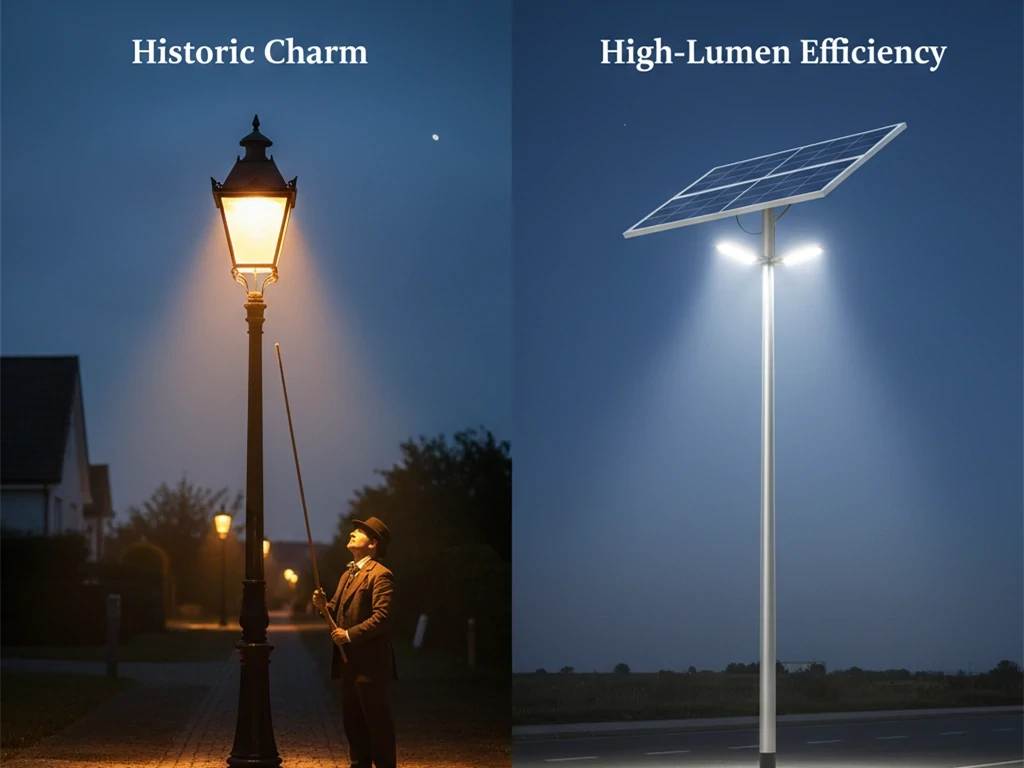
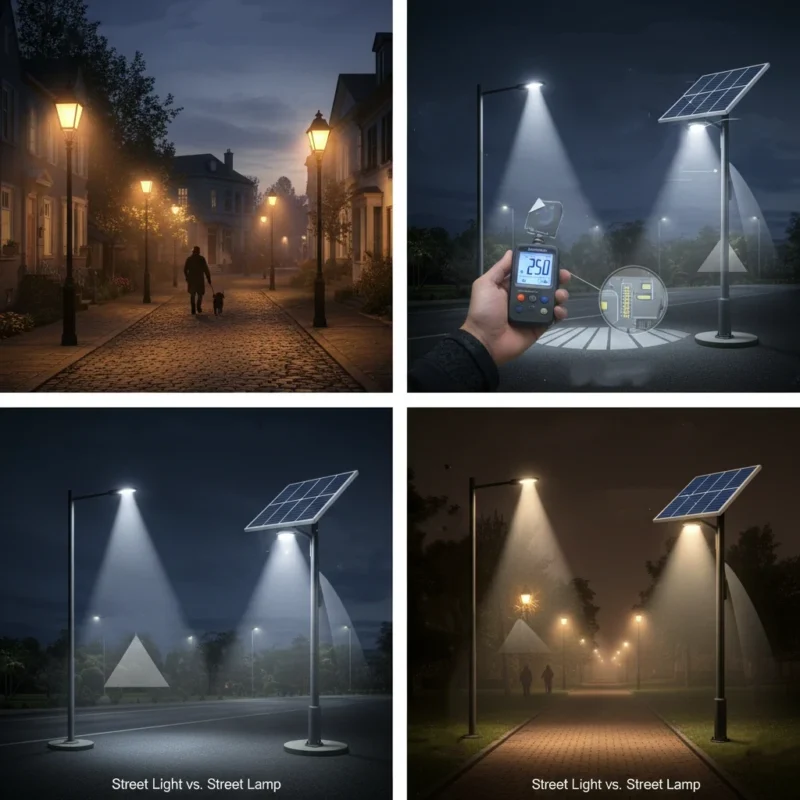
A street light is typically the utilitarian workhorse. Think of the “cobra head” fixtures perched atop 30-foot galvanized steel poles along the interstate. Their job is pure function: high-output illumination with a wide “batwing” distribution pattern to ensure drivers can see obstacles from a distance.
On the flip side, a light street lamp (or simply a “street lamp”) often refers to the more aesthetic, post-top fixtures. These are the backbone of streetlights residential projects. They look like lanterns, globes, or acorns. While a street light screams “utility,” a light street lamp whispers “ambience and safety.”
The Role of the Modern Street Light Bulb
The heart of any fixture is the street light bulb. For decades, we relied on High-Pressure Sodium (HPS) bulbs—those orange-hued lights that made everything look like a scene from a 1970s crime thriller. Today, the industry has shifted almost entirely to LED modules. Unlike a traditional street light bulb, modern LEDs aren’t always a “bulb” you can unscrew; they are often integrated diode arrays designed to last 50,000 to 100,000 hours.
Expert Insight
Why does this matter? Because a light street lamp in a residential area affects property values. According to urban planning experts, “well-scaled, warm-toned lighting can increase pedestrian traffic and perceived safety by up to 20% compared to harsh, industrial-grade flooding.”
Determining Technical Specifications: Lumens and Power
When I consult on municipal or private residential projects, the most common point of confusion isn’t the style of the fixture, but the “math” behind the glow. In the days of the traditional street light bulb, we bought based on wattage—a 100W bulb was “bright,” and a 400W bulb was “industrial.”
However, in the modern era of the light street lamp, wattage is merely a measure of energy consumption, not light output. Lumens measure the total amount of visible light emitted by a source. If you’re planning streetlights residential layouts, understanding this distinction is the difference between a well-lit path and a dark, dangerous alley.
How Many Lumens is a Street Light?
The “standard” brightness for a light street lamp is a moving target because it depends entirely on the “Classification of the Roadway.” Based on IESNA (Illuminating Engineering Society of North America) guidelines, here is how the lumen count breaks down for real-world applications:
- Residential Cul-de-sacs and Local Roads: These usually require 3,000 to 5,000 lumens. This range provides enough “facial recognition” distance for pedestrians without causing “light trespass” (the technical term for light leaking into a neighbor’s bedroom window).
- Collector Roads: These are the veins of a suburb that lead to main roads. They typically demand 8,000 to 12,000 lumens because the traffic moves faster, requiring a longer stopping distance.
- Major Arterials and Highways: For high-speed safety, these fixtures can pump out 20,000 to 40,000 lumens.
When asking how many lumens is a street light, always consider the “Mounting Height.” A 5,000-lumen lamp at 10 feet feels like a spotlight; at 20 feet, it feels like a soft, ambient glow.
Lumen vs. Wattage: The Efficiency Ratio
As an expert in the field, I always tell clients to look at Luminous Efficacy. This is calculated as $Lumens / Watts$.
In 2026, a high-quality light street lamp should deliver at least 130 to 150 lumens per watt.
- An old-school HPS (High-Pressure Sodium) street light bulb might pull 100W to give you 5,000 lumens (50 lm/W).
- A modern LED light street lamp can give you that same 5,000 lumens using only about 35W.
By focusing on this ratio, you aren’t just buying a “bright” light; you are buying a cost-effective utility that pays for itself in energy savings within 18 to 24 months.
Is 5000 Lumens Bright for Outdoor Lights?
The short answer is: Yes, but context is everything. If you are a homeowner looking for a solar light to put on a pole at the end of your driveway, 5,000 lumens is substantial. To give you a relatable comparison, a standard 60-watt incandescent bulb in your living room produces about 800 lumens. Therefore, a 5,000-lumen light street lamp is equivalent to having six of those bulbs blasting from a single point.
For streetlights residential applications, 5,000 lumens is often the maximum recommended to avoid “sky glow.” If you go much higher in a residential zone without proper shielding, you’ll likely face complaints about light pollution. However, for a commercial parking lot or a dark rural intersection, 5,000 lumens is considered the entry-level “safe” brightness to deter crime and ensure visibility.
The Impact of Color Temperature (Kelvin) on Perception
Brightness isn’t just about lumens; it’s about “Visual Acuity.” A light street lamp with 5,000 lumens at 3000K (Warm White) will appear softer and more “yellow” to the human eye, which is preferred for parks and historic districts.
Conversely, a street light bulb rated at 5000K (Daylight White) will appear much “brighter” and crisper to the eye, even if the lumen count is exactly the same. This is because cooler light frequencies reflect more effectively off the grey asphalt of the road, improving contrast for drivers. For bright solar street lights, we often recommend a middle ground of 4000K to balance efficiency with community comfort.
The Rise of Sustainable Lighting: Solar Light Solutions
As an industry professional who has overseen the transition of dozens of municipalities from grid-tied systems to off-grid technology, I can tell you that the solar light has undergone a massive glow-up. Gone are the days of those flickering, dim landscape stakes. Today’s light street lamp powered by the sun is a sophisticated piece of electrical engineering that rivals high-voltage AC systems in both reliability and raw power.
For developers focusing on streetlights residential projects, the “Solar Revolution” isn’t just about saving the planet—it’s about the bottom line. Eliminating the need for copper wiring, trenching through existing pavement, and monthly utility bills makes solar the most logical choice for modern urban planning.
The Benefits of Solar for Streetlights Residential Areas
When we talk about streetlights residential applications, the primary hurdles are usually infrastructure costs and neighborhood disruption. Traditional lighting requires digging up sidewalks and lawns to lay conduit. A self-contained light street lamp bypasses this entirely.
Solar offers a unique advantage: grid independence. During a local power outage, traditional streetlights go dark, creating safety hazards. A solar light continues to illuminate the path using the energy it harvested during the day, ensuring that residential security isn’t tied to the stability of the local power grid.
Finding the Most Bright Solar Street Lights
If you are searching for bright solar street lights, you have to look beyond the marketing stickers. The “brightness” of a solar fixture is actually a dance between three components: the Photovoltaic (PV) panel, the Battery capacity, and the LED chip efficiency.
To ensure you are getting a truly professional-grade light street lamp, look for these technical markers:
- Mono-crystalline Panels: These offer the highest conversion rates (often above 21%), which is essential for charging during cloudy winter months.
- LiFePO4 Batteries: This is the gold standard for solar light storage. These batteries last longer, handle heat better, and can discharge more deeply without damage compared to old lead-acid or standard lithium-ion versions.
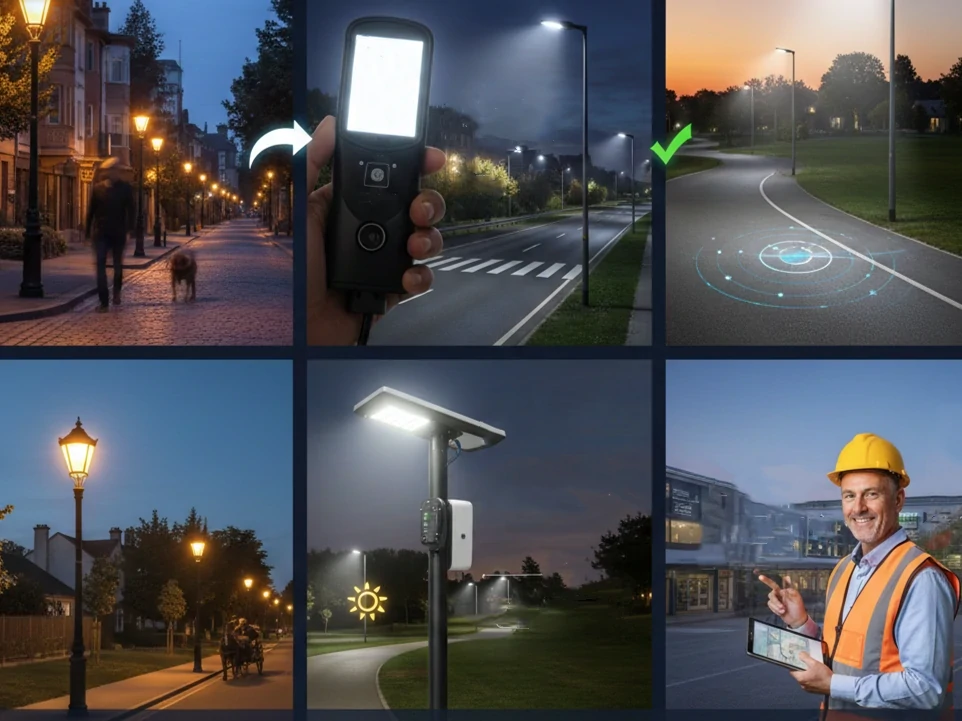
- Adaptive Lighting Modes: The most bright solar street lights use PIR (Passive Infrared) sensors. They might stay at 30% brightness to conserve energy but jump to 100% (full lumen output) the moment they detect a pedestrian or vehicle.
Technical Limits: What is the highest number of lumens for solar lights?
This is a question I get from industrial site managers constantly. While a standard street light bulb plugged into a wall can theoretically go as high as the heat sink allows, a solar light is limited by its “energy budget.”
Currently, the ceiling for a reliable, high-performance light street lamp in the solar category is approximately 15,000 to 20,000 lumens.
- Residential Solar: Typically hovers between 2,000 and 5,000 lumens.
- Industrial Solar: Can reach that 20,000 lumen mark, but it requires a massive solar panel (often separate from the light head) to gather enough energy to sustain that output through the night.
Be wary of products claiming “100,000 lumens” for a $50 solar unit. In the world of professional lighting, if the panel isn’t at least the size of a medium suitcase, it physically cannot generate enough power to support those numbers. True bright solar street lights are substantial pieces of hardware designed to withstand the elements while maintaining a steady, safe light level.
Efficiency and the “Smart” Controller
The “brain” of a modern light street lamp is its MPPT (Maximum Power Point Tracking) controller. This device acts like a sophisticated car transmission for your solar light, constantly adjusting the voltage and current to ensure that even on a rainy Tuesday in November, your battery is getting the maximum possible charge. This level of expertise in hardware selection is what separates a DIY project from a professional-grade installation.
Planning Your Installation: Height and Placement
In my years as a lighting consultant, I’ve seen thousands of dollars wasted on high-end hardware that fails simply because it was installed at the wrong height or spaced poorly. When you install a light street lamp, you aren’t just putting a “bulb on a stick”—you are designing a photometric environment.
For streetlights residential projects, improper placement leads to “zebra striping”—those jarring patches of intense light followed by pitch-black shadows. Not only is this aesthetically unpleasing, but it’s also a major safety liability. Pedestrians’ eyes cannot adjust quickly enough to the rapid change in contrast, creating “blind spots” where hazards can hide.
How Tall is a Street Light?
The mounting height of your light street lamp is the single most important factor in determining the “throw” or spread of the light. If the pole is too short, the light is concentrated in a hot spot directly underneath; if it’s too tall, the foot-candles (the measure of light reaching the ground) drop significantly.
Here is the professional breakdown of standard heights:
- Residential and Pedestrian (8 to 15 feet): This is the sweet spot for streetlights residential settings. At this height, the light street lamp feels human-scaled and provides excellent illumination for sidewalks and curbs.
- Commercial and Collector Roads (20 to 30 feet): These heights are necessary for areas where you need to illuminate two to three lanes of traffic. It requires a much more powerful street light bulb or LED array to push the light down to the pavement effectively.
- Highways and Interchanges (30 to 50+ feet): These are usually “high-mast” installations. They use specialized optics to cast a very wide net of light over massive areas.
The “Spacing to Height” Ratio
A common mistake in DIY or poorly planned commercial projects is placing poles based on convenience rather than physics. To achieve a “uniformity ratio” that meets safety standards, you must calculate the distance between each light street lamp.
The industry “rule of thumb” is a 3:1 or 4:1 ratio.
- If your how tall is a street light answer is 15 feet, then your poles should be spaced roughly 45 to 60 feet apart.
- In high-security areas, you might tighten that to a 2:1 ratio to ensure there is zero “drop-off” in light levels between fixtures.
When using a solar light, this spacing is even more critical. Because you aren’t limited by underground wiring, you have the freedom to place the poles exactly where the math dictates, ensuring a seamless blanket of light across the entire property.
Selecting the Right Street Light Bulb Type and Optics
It’s not just about the height; it’s about where the light is directed. Modern LED light street lamp fixtures use specialized lenses (Optics) to shape the beam.
- Type II Optics: Long and narrow, perfect for walkways or narrow residential alleys.
- Type III Optics: The standard for most streetlights residential applications. It throws the light forward and out, covering both the road and the sidewalk.
- Type V Optics: A circular pattern, ideal for the center of a parking lot or a large open park.
When selecting your street light bulb or integrated fixture, check the IES (Illuminating Engineering Society) distribution type. Using a Type V optic on a narrow street will waste 50% of your light by shining it into people’s front yards instead of on the pavement.
Avoiding “Light Trespass” and Glare
As an expert, I always emphasize “Dark Sky” compliance. A well-designed light street lamp should be “full cutoff,” meaning no light is emitted above the 90-degree horizontal plane. This prevents light pollution and keeps the neighbors happy. If you are installing bright solar street lights, look for fixtures with a “shielded” design. This ensures that the high-lumen output stays on the ground where it belongs, rather than glaring into second-story windows.
Maintenance and Optimization
Even the most advanced light street lamp is not a “set it and forget it” piece of infrastructure. Whether you are managing a fleet of streetlights residential units or a single high-output driveway fixture, performance naturally degrades over time due to environmental factors. As an expert who has performed hundreds of site audits, I’ve found that 40% of lighting complaints aren’t due to hardware failure, but rather a lack of basic optimization.
When dealing with a solar light, maintenance is even more critical. Since these units rely on a delicate balance of daily energy harvesting and nightly discharge, small inefficiencies can lead to complete system failure during the winter months. Here is how you keep your system running at peak performance.
Cleaning the Panels for Maximum UV Absorption
The solar panel on top of your light street lamp is its lungs; if it can’t “breathe” in the sunlight, the system suffocates. In residential areas, panels often accumulate a film of pollen, bird droppings, and industrial soot.
How do I make my solar lights brighter? The simplest answer is a bucket of water and a non-abrasive microfiber cloth. A layer of dust just 2mm thick can reduce the efficiency of bright solar street lights by as much as 25%. In coastal regions, salt spray can crystallize on the surface, creating a “frosted” effect that scatters incoming photons. I recommend a bi-annual cleaning schedule—once in the spring after the pollen season and once in late autumn to prepare for the shorter, weaker sunrays of winter.
Battery Health and Lifecycle Management
The most expensive component in a modern solar light is the battery. Most high-end streetlights residential systems now use Lithium Iron Phosphate (LiFePO4) batteries because they offer over 2,000 charge cycles. However, even these have a lifespan.
If you notice your light street lamp is turning off at 2:00 AM instead of lasting until dawn, the battery is likely reaching its end-of-life or is suffering from “shallow charging.”
- Expert Tip: Every three years, check the battery terminals for corrosion.
- If you are in an extremely cold climate, ensure your battery is “heat-wrapped” or buried if it’s a split-system, as sub-zero temperatures can temporarily reduce a battery’s capacity by 30%. Replacing an aging battery can make an old solar light perform like a brand-new, high-lumen unit for a fraction of the cost of a full replacement.
Angle Adjustment and Obstruction Audits
The sun’s path across the sky changes with the seasons, but the position of your light street lamp is usually fixed. However, many professional-grade bright solar street lights feature adjustable brackets for the solar panel.
To optimize your solar light, the panel should ideally be tilted at an angle equal to your latitude. For example, if you are in Los Angeles, a 34-degree tilt is optimal. Furthermore, you must perform a “shadow audit.” A tree that was a sapling when you installed the light street lamp five years ago may now be casting a shadow over the panel for three hours a day. Even a small shadow covering 10% of a panel can cause a 50% drop in energy production due to the way solar cells are wired in series. Trimming a few branches is often the secret to restoring a bright solar street lights’ full output.
Updating the Street Light Bulb and Firmware
In modern integrated LED fixtures, you don’t typically “change the bulb,” but you can often optimize the “work mode.” Many streetlights residential fixtures come with smart controllers that allow for dimming schedules.
If your goal is to have the most bright solar street lights possible during peak hours, program the light to run at 100% output from 6:00 PM to 11:00 PM, and then drop to 30% output (or motion-sensor mode) for the rest of the night. This ensures that the energy stored in the battery is used when it matters most, preventing the fixture from “dying” before the morning commute. By managing the output of the street light bulb array, you extend the overall life of the LEDs and the battery simultaneously.
Conclusion
Choosing the right light street lamp is an investment in your property’s safety and aesthetic appeal. Whether you are looking for streetlights residential solutions to brighten up your neighborhood or you are exploring the efficiency of a modern solar light, the key is to look beyond the price tag. Focus on the lumens, the mounting height, and the quality of the street light bulb technology.
Modern bright solar street lights have proven that we can have high-output illumination without the high-output energy bill. By understanding how tall is a street light should be and how many lumens is a street light required for your specific application, you can create an outdoor space that is both functional and inviting.
Expert FAQs: Solving Real-World Lighting Problems
Which cities still have lamplighters?
While most of the world has gone digital, London still employs a small team of lamplighters to maintain the gas lamps around Buckingham Palace and Westminster. Berlin and Wroclaw, Poland, also maintain active gas-lighting districts where “lamplighters” are part of the city’s cultural fabric.
What is the difference between a street light and a street lamp?
The “street light” is the modern, high-intensity utility fixture (the “cobra head”). A light street lamp refers to the more traditional, decorative post-top fixture found in streetlights residential areas.
What kind of lamp is used in street lights?
Today, LED is king. However, you will still see High-Pressure Sodium (yellow/orange) and Metal Halide (white) bulbs in older infrastructure. For new installations, a light street lamp almost always uses integrated LED chips.
What is the highest number of lumens for solar lights?
For a reliable, commercial-grade solar light, the top end is about 20,000 lumens. Beware of consumer-grade lights claiming 50,000+ lumens; these are often “peak” ratings that the battery cannot sustain for more than a few minutes.
How do I make my solar lights brighter?
Keep the panels clean, ensure there are no shadows from growing trees, and check your controller settings. Many bright solar street lights have a “dimming” mode to save energy; you can often override this with a remote if you need full power.
Is 5000 lumens bright for outdoor lights?
Absolutely. To put it in perspective, a standard 60W indoor bulb is about 800 lumens. A 5,000-lumen light street lamp is equivalent to over six of those bulbs, making it more than enough for a residential street or a large parking area.
How many lumens is a regular street light?
A standard light street lamp on a residential corner usually puts out between 4,000 and 6,000 lumens. In high-traffic commercial zones, that number jumps to 15,000 or more.