

Table of Contents
If you have ever stood in a store aisle staring at light bulb boxes wondering why a 9-watt bulb can be brighter than a 60-watt one, you are not alone. This confusion is exactly why the question what are lumens matters more today than it ever did before.
For decades, consumers used wattage as a shortcut for brightness. That mental model worked — until energy-efficient lighting changed everything. Today, understanding what are lumens is the difference between getting lighting that feels right and ending up with a space that is too dim, too harsh, or unnecessarily expensive to run.
What Are Lumens and Why They Matter More Than Watts Today
What Are Lumens? The Scientific and Practical Definition
Let’s start at the core question: what are lumens?
Lumens measure the total amount of visible light a bulb produces. Not power. Not heat. Not electricity use. Just brightness — as perceived by the human eye.
When lighting engineers talk about brightness, they talk about lumens. When energy regulators redesigned lighting labels, they put lumens front and center. That shift happened because what are lumens answers the question consumers actually care about: How bright will this be?
From a practical standpoint:
- Higher lumens = more visible light
- Lower lumens = dimmer output
Once you understand what are lumens, choosing lighting becomes simpler and more predictable.
Lumens vs Watts: Why Consumers Were Confused for Decades
For most of the 20th century, wattage and brightness were loosely connected because incandescent bulbs were inefficient in a very consistent way. A 60-watt bulb was always brighter than a 40-watt bulb because most of the energy turned into heat, not light.
That created a habit: people equated brightness with watts.
The problem is that wattage never actually measured brightness. It measured energy consumption. When efficient lighting arrived, that shortcut collapsed. Suddenly, a low-watt bulb could outshine a high-watt one. That is why modern lighting education begins with what are lumens, not watts.
Expert Insight
Lighting specialists often explain it this way:
“Watts tell you how much energy a bulb uses. Lumens tell you how much light you get. Confusing the two leads to bad lighting decisions.”
This is why regulators now require lighting labels to prioritize lumens. The industry moved on. Consumers had to catch up.

What Does the Wattage of a Light Bulb Indicate
If you’ve ever asked yourself, what does the wattage of a light bulb indicate, you’re already ahead of most consumers.
For decades, people treated watts as a brightness scale. A 100-watt bulb was bright. A 40-watt bulb was dim. Simple, right? It worked — but only because older lighting technology was inefficient in a very predictable way.
Today, that shortcut no longer holds up. So let’s clear this up once and for all.
Wattage Measures Energy Consumption — Not Brightness
The wattage of a light bulb indicates how much electrical power the bulb consumes, not how bright it is.
A watt is a unit of power. In simple terms, it tells you how much electricity is being pulled from the circuit at any given moment. If a bulb is rated at 10 watts, it consumes 10 joules of energy per second while operating.
That’s it.
It does not tell you:
- How bright the light will appear
- How far the light will spread
- How evenly a room will be illuminated
- How comfortable the light will feel
This distinction matters because many consumers still assume higher wattage equals higher brightness. That assumption only worked during the incandescent era.
Why Wattage Used to Seem Like a Brightness Scale
Before energy-efficient lighting, incandescent bulbs dominated the market. These bulbs converted most of their energy into heat, with only a small portion becoming visible light.
Because the inefficiency was consistent, more watts generally meant more light. So people learned to associate:
- 40 watts → dim
- 60 watts → moderate
- 100 watts → bright
But even then, wattage wasn’t technically measuring brightness. It was just indirectly correlated with it.
Once modern lighting technology improved efficiency, that relationship broke down. That’s why understanding what does the wattage of a light bulb indicate is essential in today’s market.
Does Higher Watts Mean More Power? Yes — And That’s Important
Here’s where wattage does matter.
Higher watts mean higher electrical power consumption. If two bulbs run for the same number of hours, the higher-watt bulb will use more electricity.
This affects:
- Your utility bill
- Circuit load limits
- Fixture heat buildup
- Long-term operating costs
For example, if you run a 15-watt bulb for 1,000 hours, it consumes 15 kilowatt-hours of electricity. A 9-watt bulb running the same duration uses only 9 kilowatt-hours. Over time, that difference adds up.
So while wattage doesn’t define brightness, it absolutely defines energy use.
What Wattage Means in LED Lighting
When people talk about “watt in LED,” they often misunderstand what they’re looking at.
In LED lighting, wattage still indicates energy consumption — but LEDs are dramatically more efficient than older technologies. That means a low-watt LED can produce the same brightness as a high-watt incandescent bulb.
For example:
- A traditional 60-watt incandescent bulb produced about 800 lumens.
- An LED can produce the same 800 lumens using roughly 8–10 watts.
So if you’re comparing products and asking, what does the wattage of a light bulb indicate, the answer remains consistent: it indicates power draw — not light output.
Does Higher Wattage Mean Brighter? Not Anymore
One of the most common online searches is: does higher wattage mean brighter?
In modern lighting, the answer is no.
Brightness is measured in lumens. Two LED bulbs can both consume 10 watts but produce different lumen outputs depending on their design, driver efficiency, and thermal management.
In fact, a poorly designed high-watt LED may produce fewer lumens than a well-designed lower-watt model. That’s why professionals always compare lumens first and wattage second.
Why Wattage Still Matters in Real-World Applications
Even though wattage doesn’t measure brightness, it still plays a critical role in lighting decisions.
- Electrical Safety Fixtures and circuits have maximum wattage ratings. Exceeding them can cause overheating.
- Energy Budgeting Commercial buildings calculate total connected load to manage energy consumption.
- Heat Management Higher wattage typically generates more heat, which can shorten lifespan in enclosed fixtures.
- System Design In large-scale lighting layouts, engineers calculate total wattage to ensure panels and breakers can handle the load.
In other words, wattage is about infrastructure and cost — not illumination quality.
How to Use Wattage Correctly When Buying a Bulb
Here’s the practical approach professionals use:
- Determine the brightness you need (in lumens).
- Check wattage to confirm energy efficiency.
- Ensure the wattage does not exceed fixture limits.
- Evaluate lumens-per-watt for performance comparison.
This method prevents two common mistakes:
- Overpaying for electricity due to unnecessary high watt use
- Under-lighting a space by assuming wattage equals brightness
Expert Perspective: Why Misunderstanding Wattage Leads to Poor Lighting
Lighting consultants often see two recurring issues:
- Homeowners buying “high watt” bulbs expecting extra brightness
- Businesses choosing low watt products without verifying lumen output
Both mistakes stem from not fully understanding what does the wattage of a light bulb indicate.
Wattage is about how much you spend to power the bulb, not how much light you receive. Once you internalize that, your lighting decisions become smarter, safer, and more cost-effective.
Does Higher Wattage Mean Brighter Light? The Real Answer
Incandescent Era vs Modern LED Era
Historically, the answer to “does higher wattage mean brighter” was mostly yes — because incandescent bulbs wasted energy in predictable ways.
That logic does not apply anymore.
In modern lighting, asking does higher wattage mean brighter is the wrong question. The right question is: How many lumens does this bulb produce per watt?
Does Higher Wattage Mean Brighter in LEDs
Here is the blunt truth: No.
With LEDs, higher wattage does not guarantee higher brightness. Two LED bulbs can consume the same watts and produce very different lumen outputs.
That is why lighting professionals focus on:
- Total lumens
- Lumens per watt
- Optical design
The myth that does higher wattage mean brighter persists because old habits die hard.
High Watt vs High Lumens — What You Should Actually Compare
When comparing products, always prioritize:
- Lumens
- Beam spread
- Color quality
A high watt LED that produces fewer lumens than a lower-watt alternative is simply inefficient. Smart buyers compare output, not just power draw.
LED Light Watts vs Incandescent Watts
If you’re comparing bulbs and feeling confused, you’re not alone. The debate around LED light watts vs incandescent is one of the most misunderstood topics in residential and commercial lighting.
For decades, consumers relied on wattage as a shorthand for brightness. That mental model worked when incandescent bulbs dominated the market. But once LED technology became mainstream, the entire system shifted. The numbers look smaller. The brightness looks similar — or better. And suddenly, wattage doesn’t tell the same story anymore.
To make smart decisions, you have to understand how LED light watts vs incandescent actually works in real-world performance, not marketing language.
Why LED Watts Are Not the Same as Incandescent Watts
Let’s start with physics.
Incandescent bulbs produce light by heating a filament until it glows. That process is extremely inefficient. Roughly 80–90% of the energy consumed becomes heat, not visible light. The bulb gets hot because most of the electricity is wasted.
LEDs work differently. They use semiconductors to convert electricity directly into light. Much less energy is lost as heat. That means far more of the power drawn actually becomes usable illumination.
This efficiency difference explains why LED light watts vs incandescent cannot be compared one-to-one.
For example:
- A 60-watt incandescent bulb produces around 800 lumens.
- An LED can produce those same 800 lumens using only 8–10 watts.
Both deliver similar brightness. One consumes six to seven times more electricity.
That’s why asking whether LED watts are “the same” as incandescent watts misses the point. A watt is always a watt — it measures energy consumption. But because LEDs are dramatically more efficient, they produce more lumens per watt.
In professional lighting design, we evaluate performance using lumens per watt (lm/W). Incandescent bulbs typically operate around 10–15 lumens per watt. Quality LEDs often exceed 80–100 lumens per watt or more. That efficiency gap is the real story behind LED light watts vs incandescent comparisons.
Equivalent Wattage Explained (LED vs Incandescent)
When you shop for LED bulbs, you’ll often see phrases like “60-watt equivalent” or “100-watt replacement.” This is called equivalent wattage.
Equivalent wattage is not a measurement of actual power consumption. It is a translation tool meant to help consumers who are used to the old incandescent brightness scale.
Here’s how equivalent wattage works in practice:
- 40-watt incandescent ≈ 450 lumens
- 60-watt incandescent ≈ 800 lumens
- 75-watt incandescent ≈ 1100 lumens
- 100-watt incandescent ≈ 1600 lumens
LED versions producing those same lumen outputs typically consume:
- 4–6 watts for ~450 lumens
- 8–10 watts for ~800 lumens
- 12–15 watts for ~1100 lumens
- 14–18 watts for ~1600 lumens
So when evaluating LED light watts vs incandescent, ignore the large “equivalent” number and focus on two things:
- Total lumens (brightness)
- Actual watts (energy use)
This approach prevents common mistakes, such as buying a bulb labeled “100-watt equivalent” and assuming it draws 100 watts. It does not. It simply produces brightness similar to what a 100-watt incandescent used to produce.
Another critical factor: not all LEDs with the same wattage produce the same lumens. Efficiency varies based on design, thermal management, and optical engineering. That’s why professionals always verify lumen output instead of relying solely on equivalent watt claims.
Expert Recommendation
After years of consulting on residential retrofits and commercial upgrades, here’s the practical advice professionals give:
- Always start with lumens. Brightness is determined by lumens, not watts. Decide how much light your space needs before looking at power consumption.
- Use wattage to estimate energy cost and circuit load. Lower wattage for the same lumen output means better efficiency and lower operating costs.
- Don’t compare LED watts directly to incandescent watts. When discussing LED light watts vs incandescent, remember that the technologies operate on completely different efficiency levels.
- Evaluate lumens per watt for performance quality. A lower-watt LED that produces high lumens is generally more efficient than a higher-watt LED with similar brightness.
- Consider the full lighting system. Brightness is only part of the equation. Beam angle, color temperature, and color rendering affect real-world visibility and comfort.
How Many Lumens Do You Actually Need
Once you understand what are lumens, the next logical question is practical: How many lumens do I actually need?
This is where many articles fall short. They explain what lumens are, but they don’t translate that knowledge into real decisions. In the field, lighting professionals don’t ask whether a bulb is “bright.” They ask: bright for what purpose, in what size room, and under what conditions?
The right lumen level depends on:
- Room size
- Ceiling height
- Wall and floor reflectivity
- Task requirements
- Personal comfort preferences
There is no universal number that fits every situation. But there are reliable working ranges based on decades of lighting design standards and residential retrofits.
Lumens for Common Rooms and Applications
Below are practical lumen ranges used in real residential and light commercial settings. These aren’t theoretical — they reflect what actually works.
Bedroom (Ambient Lighting) 800–1,500 lumens total per standard bedroom fixture Bedrooms are for relaxation. Over-lighting creates glare and disrupts comfort. If you’re using a single ceiling fixture, aim toward the lower end and supplement with bedside lamps.
Living Room 1,500–3,000 lumens depending on size Living spaces often need layered lighting. Instead of one extremely bright source, professionals recommend spreading lumens across multiple fixtures for balance.
Kitchen 3,000–4,000 lumens total Kitchens require higher visibility for food preparation and safety. Under-cabinet task lighting often adds 1,000–2,000 lumens in focused areas.
Bathroom 1,500–3,000 lumens Vanity lighting needs clarity without harsh shadows. Even distribution is more important than raw lumen output.
Home Office 2,000–4,000 lumens Task-heavy environments require higher illumination levels to reduce eye strain.
Garage or Workshop 3,000–6,000+ lumens Here, higher brightness improves safety and visibility. This is where many homeowners underestimate their needs.
Outdoor Security Lighting 700–2,000 lumens per fixture Placement and beam angle matter as much as lumen output.
Understanding what are lumens allows you to scale brightness intentionally rather than guessing based on outdated wattage habits.
Is 1000 Lumens Very Bright
This is one of the most searched lighting questions: Is 1000 lumens very bright?
The honest answer: it depends on context.
In a small bedroom, 1,000 lumens can feel comfortably bright — even slightly intense if the room has light-colored walls that reflect illumination efficiently.
In a living room, 1,000 lumens may feel modest and suitable for accent or task lighting rather than full-room coverage.
In a garage or workspace, 1,000 lumens is usually insufficient for full visibility. It might work for a localized task lamp, but not for general illumination.
To put it into perspective:
- A traditional 60-watt incandescent bulb produced around 800 lumens.
- 1,000 lumens is slightly brighter than that classic reference point.
So if you grew up thinking 60 watts was “normal brightness,” then yes — 1,000 lumens is moderately bright for everyday residential use.
Professionally speaking, 1,000 lumens is considered:
- Strong for table lamps
- Balanced for small rooms
- Supplemental for large spaces
The key takeaway is this: brightness perception is relative. Ceiling height, wall color, and fixture design dramatically affect how 1,000 lumens feels in real life.
What Is 2000 Lumens Mean in Real Life
Now let’s scale up.
What is 2000 lumens mean in real life?
2,000 lumens represents strong illumination suitable for larger rooms or task-heavy environments. It is roughly equivalent to combining two classic 60-watt incandescent bulbs.
In practice, 2,000 lumens:
- Fully lights a medium-sized living room
- Provides strong visibility in kitchens
- Works well for garages and workshops
- Can feel overwhelming in small bedrooms if used as a single overhead source
Here’s where experience matters. Simply installing a 2,000-lumen fixture in a compact space can create glare, hard shadows, and discomfort — especially with cool color temperatures. Lighting professionals often recommend distributing 2,000 lumens across multiple sources instead of concentrating it in one point.
For example:
- Two 1,000-lumen fixtures placed strategically create better balance than one 2,000-lumen center fixture.
- Layered lighting reduces eye strain and improves visual comfort.
From a technical standpoint, 2,000 lumens is not “extreme.” Commercial spaces frequently use much higher totals. But in residential settings, 2,000 lumens is considered strong and purposeful.
High Watt vs High Lumens in LED Products
Why Some High-Watt LEDs Are Inefficient
Not all high watt LEDs are well designed.
Common issues include:
- Poor thermal pathways
- Inefficient drivers
- Optical losses
These problems lead to lower real-world brightness despite higher watt ratings.
How to Evaluate LED Brightness Like a Pro
Professionals evaluate LEDs using:
- Lumens
- Lumens per watt
- Beam angle
- Color rendering
- Thermal performance
Once you internalize what are lumens, you start evaluating lighting like an expert.

Common Myths About Watts, Lumens, and Brightness
If you’ve made it this far, you already understand what are lumens and how they differ from watts. But in real-world lighting decisions, myths still cause confusion — even among contractors and experienced homeowners.
These misconceptions don’t just lead to minor mistakes. They result in overpaying for electricity, under-lighting critical work areas, and creating uncomfortable glare in living spaces.
Let’s address the most common myths professionals encounter in the field — and replace them with practical, experience-backed clarity.
Myth 1: Higher Watts Always Mean Brighter Light
This belief made sense decades ago. In the incandescent era, higher wattage generally meant higher brightness because inefficient bulbs wasted energy in predictable ways. More watts meant more heat — and incidentally, more light.
But that relationship no longer holds true.
Today, asking whether higher wattage means brighter is asking the wrong question. Wattage measures power consumption. Brightness is measured in lumens.
Two modern bulbs can both consume 10 watts and produce completely different brightness levels. One might deliver 800 lumens. Another might produce 1,100 lumens. The difference lies in design efficiency, not power draw.
Professionals evaluate lighting using lumens per watt — a measurement of how effectively a product converts electricity into visible light. That efficiency varies widely across technologies.
If you remember one rule, it’s this:
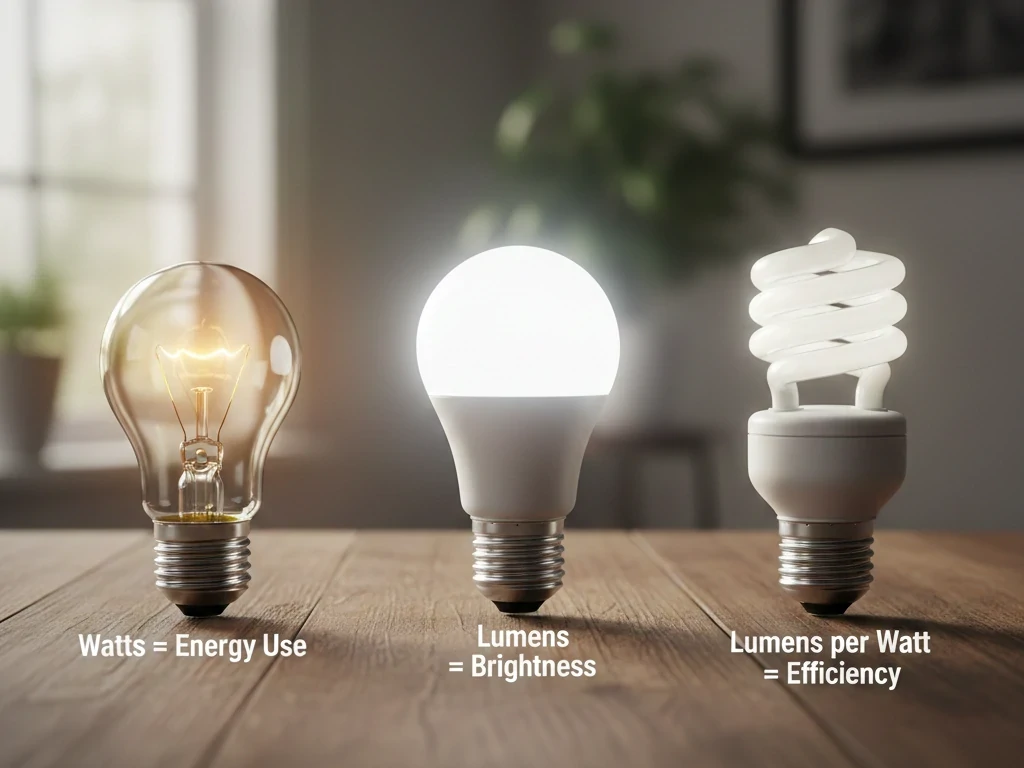
- Watts = energy used
- Lumens = light produced
Understanding what are lumens eliminates the outdated assumption that more power automatically equals more brightness.
Myth 2: LED Watts Equal Incandescent Watts
Another widespread misconception is that LED wattage corresponds directly to incandescent wattage.
This confusion stems from “equivalent wattage” marketing language. When a bulb says “60-watt equivalent,” it does not mean the bulb consumes 60 watts. It means the bulb produces roughly the same brightness that a 60-watt incandescent once did.
In reality:
- A 60-watt incandescent produced about 800 lumens.
- An LED can produce 800 lumens using roughly 8–10 watts.
This massive efficiency difference is why direct watt-to-watt comparisons fail. When evaluating LED light watts vs incandescent, you must compare lumens — not watts.
Professionals never compare wattage across technologies without referencing lumen output. Doing so leads to underpowered installations or unnecessary energy waste.
Myth 3: More Lumens Are Always Better
Once people learn what are lumens, they sometimes swing too far in the opposite direction. They assume more lumens always means better lighting.
That’s not how good lighting works.
Over-illumination can cause:
- Glare
- Eye fatigue
- Harsh shadows
- Reduced visual comfort
- Washed-out interior design
For example, installing a 2,000-lumen fixture in a small bedroom can feel clinical and uncomfortable. In contrast, spreading that same 2,000 lumens across layered sources creates a balanced and inviting atmosphere.
Professional lighting design is about matching lumen output to purpose — not maximizing brightness blindly.
Myth 4: Wattage Doesn’t Matter Anymore
Now that you understand what are lumens, it might be tempting to ignore wattage entirely. That would be a mistake.
Wattage still matters for:
- Energy budgeting
- Circuit load limits
- Fixture safety ratings
- Long-term operating costs
A lower-watt bulb delivering the same lumens is generally more efficient — but you must ensure the fixture and electrical system can safely support the chosen product.
Lighting decisions require balancing lumens and watts — not ignoring one in favor of the other.
Myth 5: Brightness Is the Only Factor That Matters
Brightness is critical, but it’s only part of the equation.
Color temperature, beam angle, distribution, and color rendering dramatically influence how light feels and performs in a space.
Two bulbs producing identical lumens can create entirely different experiences depending on:
- Warm vs cool tone
- Narrow vs wide beam
- Direct vs diffused output
Professionals approach lighting holistically. They start with what are lumens, but they finish with a complete visual strategy.
Myth 6: If It Looks Bright in the Package, It Will Light the Room Well
This assumption leads to frequent disappointment.
A bulb may appear bright when viewed directly, but poor beam spread or optical design can leave dark corners in the room. Lumen output must be paired with thoughtful placement.
Brightness perception is influenced by:
- Ceiling height
- Wall reflectivity
- Surface color
- Fixture position
That’s why experienced installers evaluate total room lumens — not just the bulb’s individual rating.
Why These Myths Persist
Most lighting confusion comes from legacy habits. For generations, consumers used watts as their brightness reference point. Changing that mindset takes time.
Education around what are lumens has improved, but online misinformation still reinforces outdated assumptions. The result? People either overspend on “high watt” bulbs or under-light essential spaces.
Professional lighting design eliminates guesswork by focusing on measurable output, not intuition.
The Professional Perspective
In practical terms, here’s how experts avoid these myths:
- Determine required lumens based on room function.
- Compare products using lumens per watt.
- Verify wattage for electrical compatibility.
- Evaluate beam angle and color temperature.
- Distribute light evenly instead of concentrating it.
This method ensures:
- Efficient energy use
- Comfortable illumination
- Long-term cost control
- Safe electrical operation
Final Takeaway — How to Choose the Right Light Bulb with Confidence
The Simple Rule
- Lumens = brightness
- Watts = energy use
Once you understand what are lumens, lighting stops being confusing and starts being predictable.
Expert Buying Checklist
Before buying any bulb:
- Check lumens first
- Match brightness to room purpose
- Confirm wattage for electrical safety
- Avoid relying on old watt-based assumptions
This approach works whether you are replacing a single bulb or designing an entire lighting system.
Answering the Most Searched Questions About Lumens and Wattage
Does higher lumens mean brighter?
Yes. Higher lumens always mean more visible light output.
Lumens measure brightness. If one bulb produces 1,200 lumens and another produces 800 lumens, the 1,200-lumen bulb emits more total light.
However, perceived brightness also depends on:
• Room size
• Ceiling height
• Wall reflectivity
• Beam angle
• Color temperature
For example, 1,000 lumens in a small bedroom can feel bright. The same 1,000 lumens in a large garage may feel insufficient.
So while higher lumens objectively mean brighter output, how bright it feels depends on context. That’s why understanding what are lumens is the foundation of accurate lighting decisions.
How many lumens is a 60-watt light bulb?
A traditional 60-watt incandescent bulb produces approximately 800 lumens.
This number became the reference point for decades. Many people still think in terms of “60-watt brightness,” but what they’re really remembering is about 800 lumens of output.
Modern LED bulbs can produce those same 800 lumens while consuming roughly 8–10 watts of power. That dramatic efficiency difference is why comparing LED light watts vs incandescent watts requires looking at lumens first, not wattage.
If you’re replacing an old 60-watt bulb and want similar brightness, look for around 800 lumens — regardless of the watt rating.
Is 1000 lumens very bright?
It depends on the application.
In practical terms, 1,000 lumens is:
• Bright for a bedside lamp
• Comfortable for a small bedroom
• Suitable for task lighting at a desk
• Not enough for full illumination in a large garage
To give perspective, 1,000 lumens is slightly brighter than a traditional 60-watt incandescent bulb.
Professionally speaking, 1,000 lumens is considered moderate indoor brightness. It’s versatile, but rarely overwhelming — unless placed in a very small space with reflective surfaces.
When evaluating whether 1,000 lumens is “very bright,” always consider square footage and purpose.
What is 2000 lumens mean?
2,000 lumens represents strong, high-output illumination.
In real-world applications, 2,000 lumens is appropriate for:
• Medium-sized living rooms
• Kitchens requiring strong task visibility
• Workshops and garages
• Outdoor security lighting
For comparison, 2,000 lumens is roughly equivalent to combining two traditional 60-watt incandescent bulbs.
In smaller rooms, a single 2,000-lumen fixture can feel harsh or overly intense. Professionals often recommend distributing that brightness across multiple light sources to reduce glare and create balance.
Understanding what are lumens helps you scale brightness logically instead of guessing based on old wattage habits.
Does higher watts mean more power?
Yes.
Higher wattage means greater electrical power consumption. A 15-watt bulb consumes more electricity than a 9-watt bulb when operated for the same duration.
This affects:
• Energy bills
• Circuit load planning
• Heat output
• Long-term operating costs
Wattage is about energy use — not brightness. That distinction is critical for making cost-effective lighting decisions.
Does higher watts mean brighter light?
Not necessarily.
In the past, higher wattage usually meant brighter light because incandescent bulbs were inefficient in consistent ways. That relationship no longer applies in modern lighting technology.
Today, brightness depends on lumens. Two bulbs with identical wattage can produce different lumen outputs depending on their efficiency.
When people ask whether higher wattage means brighter, the accurate answer is: only if the lumen output is higher. Wattage alone does not guarantee brightness.
This is one of the most persistent myths in lighting — and one of the easiest to avoid once you understand what are lumens.
Are LED watts the same as incandescent watts?
No.
A watt is always a unit of power, but LED technology converts electricity into light far more efficiently than incandescent technology.
For example:
• 60-watt incandescent ≈ 800 lumens
• 8–10 watt LED ≈ 800 lumens
That means LED watts vs incandescent watts cannot be compared directly when discussing brightness.
When choosing lighting, always:
1. Check lumens for brightness.
2. Check watts for energy consumption.
3. Confirm compatibility with your fixture.
Professionals evaluate lumens per watt to measure efficiency — not wattage alone.